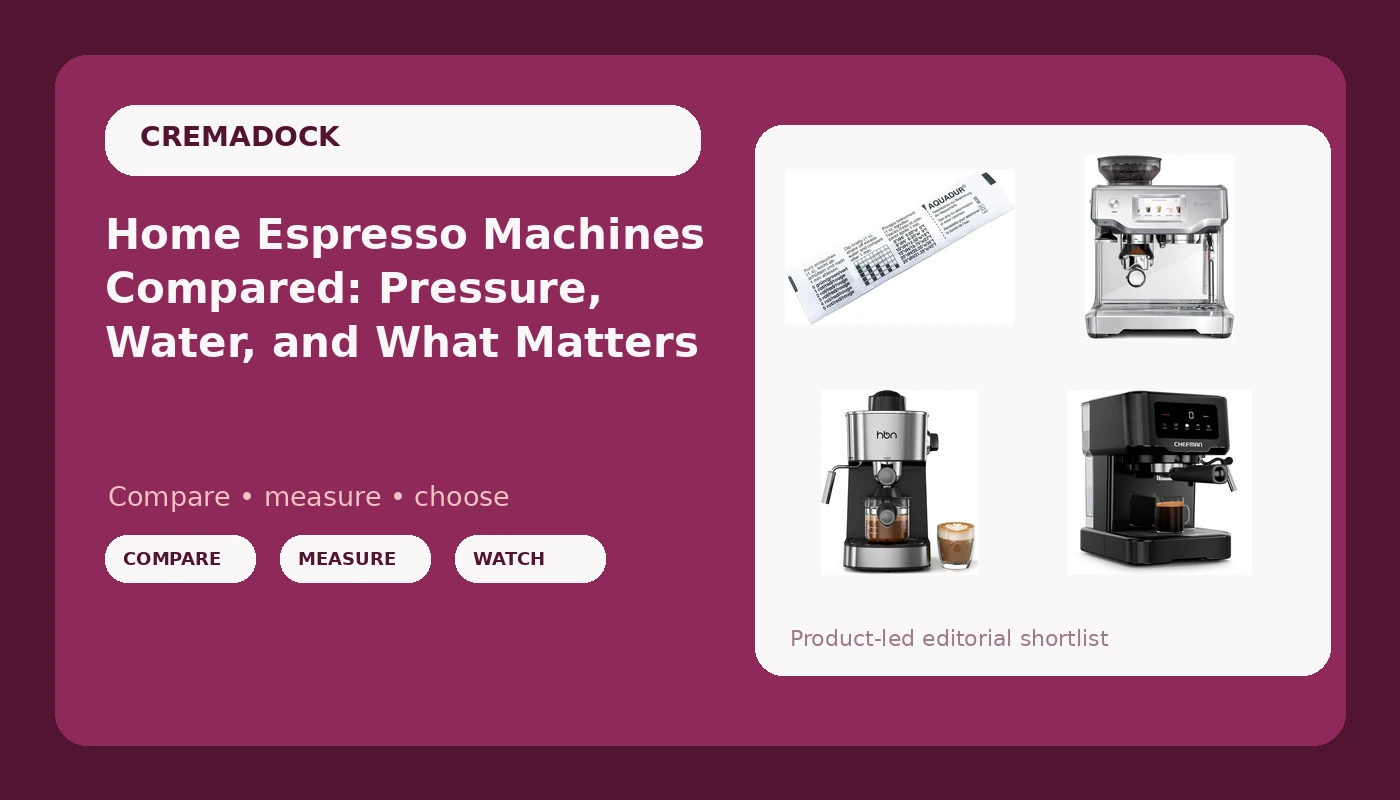
Shopping for home espresso machines is mostly an exercise in decoding numbers that do not mean what the packaging implies. A 15-bar pump does not brew at 15 bar. A 3.5-bar steam machine is not a weaker version of the same appliance, it is a different appliance wearing the same word. And the water going into any of them decides how long the thing survives, which is why a two-pack of test strips belongs in the same cart as the machine. The four items below cover the actual range you are choosing between: an all-in-one machine from Breville's Barista line, a lower-cost 15-bar pump machine with a removable reservoir, a compact steam-pressure maker for small counters, and the cheap accessory that tells you when your water is quietly killing your boiler.
Related: How to Build a Descale Schedule You Will Actually Follow →
Quick answer
If you want one unit that handles the whole morning routine in a single footprint, the Breville BES880BSS Barista Touch is the most complete machine in this group. If you want to spend less on the machine itself, the Chefman CraftBrew gives you a 15-bar pump, a steam wand, and a 1.5L removable water reservoir. If your counter is tiny and you want a simple 2 to 4 cup milk drink maker, the HBN Espresso Machine fits that role. And regardless of which machine you buy, a pack of hard water test strips is the cheapest way to learn what your tap water is doing to it.
Four useful options
| Model | Best fit | What stands out |
|---|---|---|
| Breville BES880BSS Barista Touch | One machine, full routine | Brushed stainless steel, model-specific BES880BSS configuration |
| Chefman CraftBrew | Budget pump machine with a steam wand | 15-bar pump, 1.5L removable reservoir, digital controls |
| HBN Espresso Machine | Very small counters, simple milk drinks | 3.5-bar system, 800W, 2 to 4 cup capacity, milk frother |
| Hard Water Test Strip, pack of 2 | Anyone with an espresso machine | Listed for Breville and De'Longhi models and other domestic machines |
The all-in-one: Breville BES880BSS Barista Touch
The trade-off with any all-in-one is that you are buying one appliance instead of two, which is wonderful right up until something needs attention. One machine means one descale schedule, one water filter to track, one grouphead to brush out, and one power cord. It also means you are not shopping for a separate burr grinder, which is where a lot of budget espresso setups quietly fall apart: people spend on the machine and then grind with a blade chopper, and every shot tastes like it was pulled through gravel. The other side of the coin is repairability. A machine with more integrated parts tends to be a machine where a single failure takes the whole unit offline, so the maintenance habits in the second half of this article matter more here, not less.
The budget pump machine: Chefman CraftBrew
A removable 1.5L reservoir sounds like a minor spec until you have owned a machine where you cannot see the water level from the front. That is how boilers run dry, and running a boiler dry is one of the fastest ways to shorten a machine's life. Being able to lift the tank out means you can fill it at the sink, rinse it properly instead of just topping it off, and actually see what is growing in there. The 15-bar figure describes the pump's capability, not the pressure at the group, which is covered below. What you are getting at this tier is a pump-driven machine with a steam wand and digital controls, and what you are accepting is that the internals are built to a price, which makes descaling on schedule a genuinely load-bearing habit rather than an optional chore.
The compact steam-pressure maker: HBN Espresso Machine
This is the item where expectations matter most, because the 3.5-bar number tells you exactly what kind of machine it is. Espresso extraction is defined by brewing under pressure in the neighborhood of nine bar at the group, which is why pump machines exist. A 3.5-bar machine works on steam pressure instead, and that generally means a pressurized basket and a drink that is closer to a strong, concentrated coffee with a frothy top than a true espresso shot with a distinct crema layer. That is not a defect, it is a category. If your goal is a two-cup cappuccino on a small counter without a grinder, a scale, or a learning curve, this is the shape of machine that does it. If your goal is chasing a specific shot profile, this is not the tool, and no amount of technique will change that.
The maintenance accessory: Hard Water Test Strip, pack of 2
Test strips are the least exciting item here and probably the most consequential. Every descale schedule you read is written for average water, and almost nobody has average water. Hard water scales a boiler faster; soft water can be aggressive in a different way. Breville machines in the Barista and Oracle families let you set a water hardness value in the menu, and that setting drives the descale reminder. Guessing at that number is how people end up either descaling far too often or, more commonly, far too late, after the mineral has already baked onto the heating element. Two strips in a pack means you can test your tap once and retest later, or test the filtered water you switched to, and find out whether the filter is actually doing anything.
Prices and availability may change. Product names, images, and retailer links are matched to verified listings. No current price, rating, stock status, or measured result is stated here without current evidence.
What pump pressure ratings actually mean
The number on the box describes the pump, not the coffee. A 15-bar pump is a pump that can generate up to 15 bar of pressure, and that headroom exists partly so the machine can recover quickly and partly because pump specs sell machines. What actually reaches the puck is regulated much lower, in the range that espresso is defined by. If a machine has a pressure gauge, the gauge is telling you the number that matters, and it is worth learning to read it, because it will tell you more about what is happening in the group than any marketing figure.
The practical consequence is that a higher bar rating does not automatically mean better coffee. Two machines with the same pump rating can behave completely differently depending on the basket, the grind, and how the machine is regulated. This is also why grind matters so much. A pump machine pushing water through a coarse, uneven grind will channel, and channelling produces sour and bitter notes in the same shot no matter how much the machine cost. If you are comparing a 15-bar machine against a 3.5-bar machine, you are not comparing a strong version and a weak version of one product. You are comparing a pump-driven machine that can be tuned toward real espresso against a steam-pressure machine designed to produce a concentrated milk drink with minimal fuss.
Water hardness is the maintenance contract
Espresso machines do not usually die of old age. They die of scale, neglect, and dry boilers, in roughly that order. Scale is dissolved mineral that comes out of solution when water is heated and then deposits on the inside of the boiler and the thermoblock. It insulates the heating element, forces the machine to work harder, restricts flow, and eventually causes the kind of failure that sends a machine to the curb. The rate at which that happens is entirely a function of your water.
This is why the descale interval is not a universal number. A machine on very hard well water might need descaling several times more often than the same machine on soft municipal water. The sequence that actually works is to measure your water first, then set your machine's hardness setting to match, then follow the reminder instead of a calendar you invented. Use a proper descaling solution rather than vinegar, run the full cycle including the rinse, and do not skip the rinse because the machine smells like a lemon. Backflush the grouphead on a regular schedule if your machine supports it, and keep the reservoir clean rather than merely full. None of this is difficult. It is just the difference between a machine that lasts and a machine that becomes a story about how they do not make them like they used to.
- Test your water with a strip before you decide anything about descale frequency.
- Set the machine's water hardness value to match what the strip tells you, so the reminder is meaningful.
- Buy descaling solution and a backflush routine at the same time you buy the machine, not after the first clog.
- Descale on the machine's reminder or on a written schedule, and complete the full rinse cycle every time.
- Keep the reservoir removable, clean, and above the minimum line, and never let the machine run dry.
Practical guidance before you buy
- Decide first whether you already own a real burr grinder. If you do not, an all-in-one machine is often the more sensible purchase than a bare brewer plus a separate grinder.
- Check where the water reservoir sits and whether you can see or remove it. A tank you cannot see is a tank you will run dry.
- Match the machine to the drink you actually order. If you drink two-cup cappuccinos and never pull a solo shot, a simple steam-pressure machine covers it. If you want to dial in a shot, buy the pump machine.
- Budget for consumables: descaling solution, water filters if your machine takes them, cleaning tablets, and a strip or two to check the water. These are small line items that decide how long the machine lasts.
- Plan the counter space before the purchase, including clearance for the steam wand and room to lift the reservoir out. A machine that is awkward to fill gets filled less carefully.
Which option should you choose?
Choose the Breville BES880BSS Barista Touch when you want one machine to handle grinding, brewing, and steaming without buying a separate grinder. Choose the Chefman CraftBrew when you want a 15-bar pump machine with a steam wand and a removable 1.5L reservoir at a lower entry point. Choose the HBN Espresso Machine when your counter is small and your goal is a simple 2 to 4 cup cappuccino or latte rather than a tuned espresso shot. Add the hard water test strips in every one of those cases, because the machine you pick matters less than the water you feed it.
One caveat on the specs here: pump ratings, wattage, capacity, and reservoir size are manufacturer-stated figures, and a bar rating on a box is not the same as a measured pressure at the group. Treat the numbers as a way to sort machines into categories, not as a promise about what lands in your cup. The compatibility list on the test strips is a listing detail, not a guarantee that a strip is required for every machine named on it.
The bottom line
The four items here represent four different jobs, and the mistake is treating them as four versions of the same purchase. A pump machine with a steam wand and a removable reservoir is a platform you can grow with. A 3.5-bar steam machine is a compact appliance for milk drinks, and it does that job without pretending to be something else. An all-in-one from Breville's Barista line collapses the whole routine into one footprint. And the test strips cost almost nothing and tell you the one thing no spec sheet will: how hard your water is, and therefore how long any of these machines is likely to last. Buy the machine that matches your actual morning, then protect it like the maintenance contract it is.