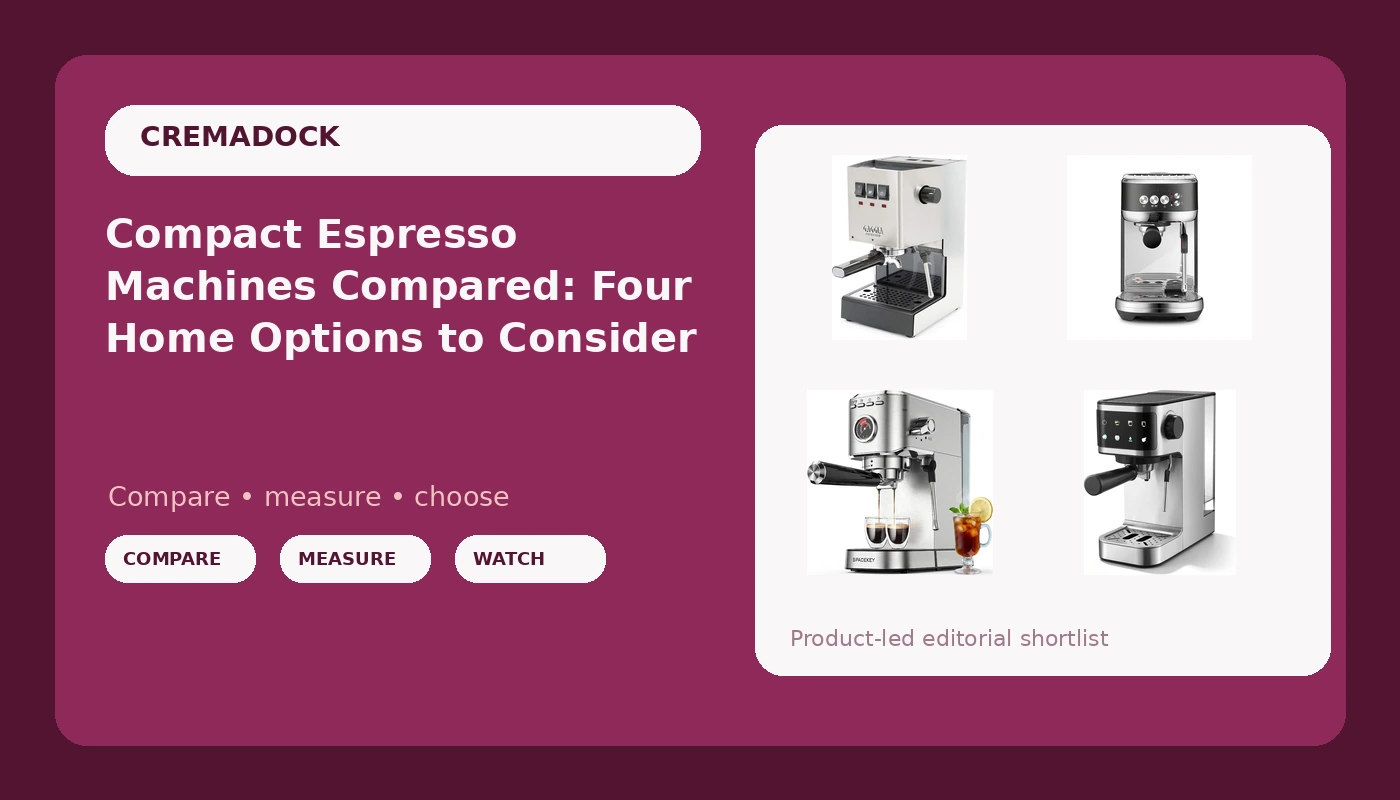
If your counter is eighteen inches wide and your budget sits somewhere between a nice dinner and a car payment, the phrase compact espresso machines covers a wider spread of hardware than most buying guides admit. Two of the machines below are 20 bar pump machines with steam wands and removable tanks. One is a brushed stainless steel machine from a name that has been sitting on home counters for decades. One is a small Breville finished in black stainless steel. All four will fit a tight corner. They are not remotely the same purchase.
That is the problem this explainer solves. A compact machine is not a compromise you settle for, it is a set of trade-offs you choose on purpose: how much counter depth you are willing to give up, how much of the work you want the machine to do for you, and how willing you are to descale, clean, and replace a part in year four instead of throwing the whole thing out. Get those three answers right and the model choice mostly makes itself. Get them wrong and the machine ends up in a cabinet behind the blender, which is the most expensive outcome of all.
Related: How to Descale an Espresso Machine Without Killing the Boiler →
Quick answer
Buy the machine whose cleaning routine you will actually perform, not the one with the longest feature list. Espresso is a maintenance contract with a pump attached: a machine that gets descaled on schedule and has its grouphead brushed out will outlast a more expensive machine that never does. Among the four options here, the decision comes down to footprint, how much of the milk and shot work you want handled for you, and whether you want a machine you can keep repairing instead of replacing. Read the maintenance and bar rating sections below before you pick, because on a compact machine the water tank, the drip tray, and the clearance under the grouphead matter more than the badge on the front.
Four useful options
| Model | Best fit | What stands out |
|---|---|---|
| Gaggia RI9380/46 E24 Espresso Machine, Brushed Stainless Steel | Someone who wants one machine to keep and service for years | Brushed stainless steel body; a design lineage that favors repair over replacement |
| Breville BES500BST Bambino Plus Espresso Machine, Black Stainless Steel | Small kitchens that want a recognized brand in a narrow footprint | Black stainless steel finish; the compact end of Breville's home lineup |
| Spacekey Espresso Machine with Milk Frother, 20 Bar Compact Expresso Coffee Machines for Home, Stainless Steel Espresso Maker with 39oz Removable Water Tank for Cappuccino Latte, Fast Heating, Silver | A first machine on a tight budget | 20 bar rating, built-in milk frother, 39oz removable water tank, fast heating |
| Espresso Machine 20 Bar, 1350W Instant Heating Coffee Maker with Stainless Steel Steam Wand & Touch Color Display, 6-in-1, 1.3L Removable Tank, Compact Stainless Steel | Buyers who want the most features per dollar | 1350W heating, 20 bar rating, 1.3L removable tank, touch color display, 6-in-1 modes, stainless steel steam wand |
The long-term pick: Gaggia RI9380/46 E24 Espresso Machine, Brushed Stainless Steel
This is the machine in the group for the person who thinks in terms of a decade rather than a holiday season. It is not the one that does the most thinking for you, and it is not the cheapest way to get a shot of espresso on a Tuesday morning. What it offers is the shape of a machine you can live with: a metal body, a straightforward workflow, and the expectation that when something wears out, you look up the part instead of the replacement.
The honest trade-off is attention. A machine in this style rewards you for weighing your dose, watching your grind, and keeping a descale schedule you actually follow. If you want a screen to tell you what to do, this is the wrong corner of the table. If you want to learn why your shot ran fast this morning, it is the right one.
The compact name-brand option: Breville BES500BST Bambino Plus Espresso Machine, Black Stainless Steel
Breville is the brand most people encounter first, and the Bambino name is the one that shows up when counter space is the limiting factor. Buying into a large brand family has practical value beyond the badge: owner communities are bigger, the vocabulary of the machine is already written down somewhere, and the upgrade path within the same ecosystem is well trodden. If you have a friend with a Breville on their counter, you have a person to text when your shot tastes thin.
The trade-off is that a compact machine in any brand means a smaller water tank and a smaller drip tray. Smaller tanks mean more refills, and more refills mean more chances to run the boiler dry, which is one of the few ways to genuinely shorten a machine's life. If you go this route, make filling the tank part of the same ritual as grinding, every single time.
The entry-level option: Spacekey Espresso Machine with Milk Frother, 20 Bar Compact Expresso Coffee Machines for Home, Stainless Steel Espresso Maker with 39oz Removable Water Tank for Cappuccino Latte, Fast Heating, Silver
The Spacekey is the least expensive way into this group, and the spec sheet is aimed squarely at the person who wants cappuccino and latte at home without committing to a hobby. The 39oz removable tank is generous for a compact body, which matters more than it sounds: fewer refills, easier rinsing, and a tank you can actually see into when you clean it. Fast heating is part of the pitch, which is the right priority for a machine that will mostly run one or two drinks at a time.
The trade-off with any entry-level machine is longevity and consistency. You are buying a pump, a heating element, and a housing, and the parts that fail first on machines in this class are the ones that cost almost as much to replace as the machine did. Treat the descale schedule as non-negotiable, use filtered water from day one, and this becomes a reasonable first step rather than a disposable one.
The feature-heavy budget option: Espresso Machine 20 Bar, 1350W Instant Heating Coffee Maker with Stainless Steel Steam Wand & Touch Color Display, 6-in-1, 1.3L Removable Tank, Compact Stainless Steel
This one is the clearest example of the current budget formula: a 1350W heating system, a 20 bar pump rating, a touch color display, a 1.3L removable tank, and a stainless steel steam wand, all in a compact body with six programmed modes. If your definition of value is features per dollar, this is where the arithmetic lands. A separate steam wand also gives you more control over milk texture than a combined frothing attachment, and milk texture is most of what separates a home latte from a sad one.
The trade-off is that displays and programmed modes do not make coffee better, they make it repeatable. Six modes means six preset timings that were chosen for a generic bean, a generic grind, and a generic palate. You will still need to dial in your grind, and you will still need to clean the steam wand after every single use, because dried milk on a wand is how you end up with a permanently clogged tip.
Prices and availability may change. Product images, names, and retailer links must be matched by verified ASIN. Do not state a current price, rating, stock status, or measured result without current evidence.
What a 20 bar rating actually tells you
Two of the machines here advertise 20 bar, and it is worth understanding what that number is and is not. Bar ratings on home machines describe the maximum pressure the pump can produce, not the pressure your coffee sees. Espresso is generally extracted somewhere in the range of eight to ten bar at the group, and a machine that cannot hold steady pressure during a shot will taste thin or harsh regardless of what the box says.
Marketing pressure numbers went up over the years the same way megapixel counts did, because bigger numbers sell. A 20 bar pump in a budget machine is not automatically better than a 15 bar pump in a machine with a more stable brew circuit. What actually moves the needle in the cup is grind consistency, dose accuracy, and temperature stability across the twenty-five to thirty seconds of the shot. If you take one thing from this section, take this: the bar number is the least useful specification on the box, and the pressure gauge, when a machine has one, tells you more than any sticker.
The maintenance math that decides how long a compact machine lasts
Every machine in this group will make acceptable espresso for a while. The difference shows up in year three, and it is decided almost entirely by water and cleaning. Scale is the slow killer: minerals plate the inside of the boiler and the thermoblock, the machine runs hotter to compensate, and eventually something fails. The machines that last are the ones where the owner treats descaling like a bill that comes due, not a suggestion in the manual.
- Measure your counter depth and the clearance above it before anything else, because a machine that does not fit gets used zero times.
- Decide whether you want a built-in frother or a separate steam wand, then practice milk texture with the one you chose rather than switching later.
- Budget for filtered water and a descaling solution at the same time you buy the machine, so the first descale is not a future project.
- Plan for a real burr grinder, because the machine is only half of the setup and a blade grinder will cap your results no matter what you buy.
- Check that the water tank is removable and visible from the front, so you never run the boiler dry.
Practical guidance for a small counter
- Fill the tank before every session rather than during it. Running a boiler dry is the fastest way to turn a working machine into a repair project.
- Rinse and wipe the steam wand immediately after steaming. Milk residue sets hard, and a clogged tip is the most common reason home milk texturing stops working.
- Descale on a schedule tied to your water hardness, not to how the machine feels. Hard water areas need it far more often than the manual's optimistic interval.
- Empty the drip tray before it overflows. On compact machines the tray is small by design, and a full tray means water pooling under the machine.
- Keep the grouphead and portafilter clean with a proper espresso cleaning product, not dish soap, and brush the shower screen weekly.
Which option should you choose?
Choose the Gaggia RI9380/46 E24 Espresso Machine, Brushed Stainless Steel when you want a machine you intend to keep, service, and learn on for years. Choose the Breville BES500BST Bambino Plus Espresso Machine, Black Stainless Steel when counter depth is the hard constraint and you want a well-known brand in the smallest possible footprint. Choose the Spacekey Espresso Machine with Milk Frother when you want a first machine with a large removable tank and a built-in frother without spending much. Choose the 1350W 20 bar machine with the touch color display and 6-in-1 modes when you want the most features for the money and you are comfortable dialing in your own grind.
A note on evidence: the bar ratings, wattage, and tank capacities above are manufacturer specifications rather than independent measurements, and prices and availability change over time. Check the current listing for dimensions, included accessories, and warranty terms before you commit, and confirm the machine fits your actual counter.
The bottom line
Compact does not mean compromised, but it does mean chosen. The two budget machines here compete on features and tank size, the Breville competes on footprint and brand familiarity, and the Gaggia competes on the thing that actually determines whether you are still pulling shots on it in five years, which is how serviceable it is. Whichever you pick, the water you put in it and the cleaning you do on schedule will matter more than the pump rating printed on the box. Buy the one you will maintain, keep a descaling routine from week one, and put the money you save on the machine into a burr grinder.