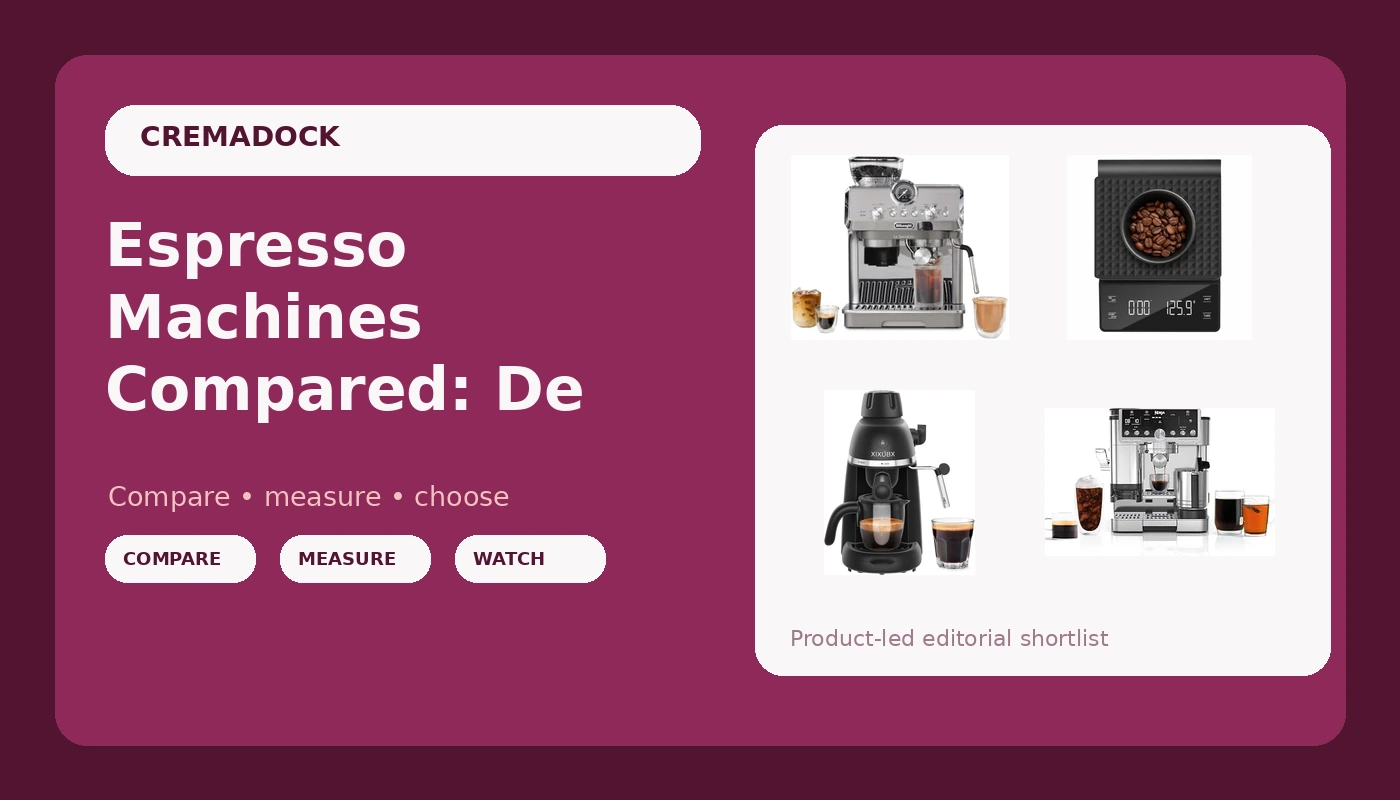
I bought my first real espresso machine in 2015, a Breville BES870XL, and ran it every single day for nine years before the automatic shot stop finally quit on me. In that time I replaced o-rings at the grouphead and the portafilter tip, swapped water filters every sixty shots or two months, descaled on a schedule like it was a mortgage payment, and gave up on a solenoid valve that started as a loud buzz and ended as water leaking from the bottom. The dead parts live in a shoebox under my sink. That history is the lens for this home espresso machines comparison, because the machine that survives nine years is almost never the one with the best marketing photo. It is the one you will actually clean.
Related: Espresso Machine Descale Schedule And Water Filters
The short answer: if you want one box that grinds and pulls, the De'Longhi La Specialista Arte Evo is the pick for most people, because the grinder is half the machine and it is the only machine here that includes one. If you want a single appliance that also makes cold brew and hot water, the Ninja Luxe Café Pro Series ES701 earns its counter space. If you are spending the least, the XIXUBX is a coffee-and-milk machine, not an espresso machine, and you should walk in knowing that. And whatever you buy, the NKOVE scale is the cheapest upgrade that actually changes what lands in your cup.
One thing before the table: I have not put months of daily shots through all four of these on my own counter, and I am not going to pretend I have. What follows is the countertop math I would do before spending my own money, plus the maintenance questions I ask about every machine, which is usually the part buying guides go quiet about.
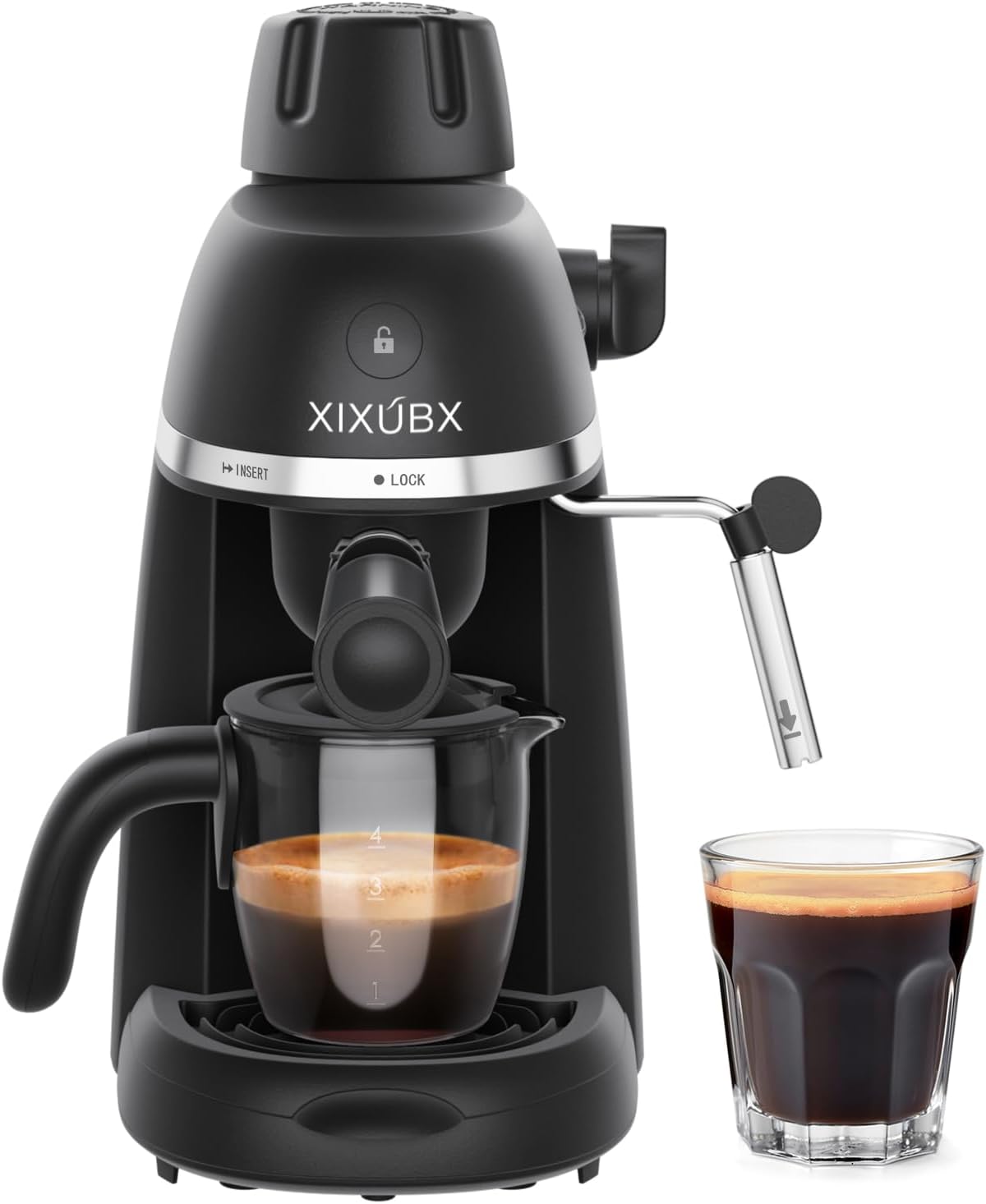
XIXUBX Compact Espresso & Cappuccino Machine, 3.5 Bar with Steam Wand
The cheapest way onto the counter, with a small footprint and a steam wand for milk
3.5 bar of pressure is nowhere near the 9 bar convention, so it makes strong coffee drinks, not dialed-in espresso
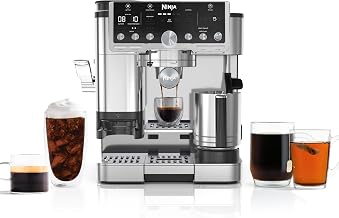
Ninja Luxe Café Pro Series, Espresso, Cold Brew, Hot Water, ES701
Espresso, cold brew, and hot water in one footprint, which is a real argument in a small kitchen
Three jobs in one box means more to clean and more to break, and you are paying for convenience over shot quality
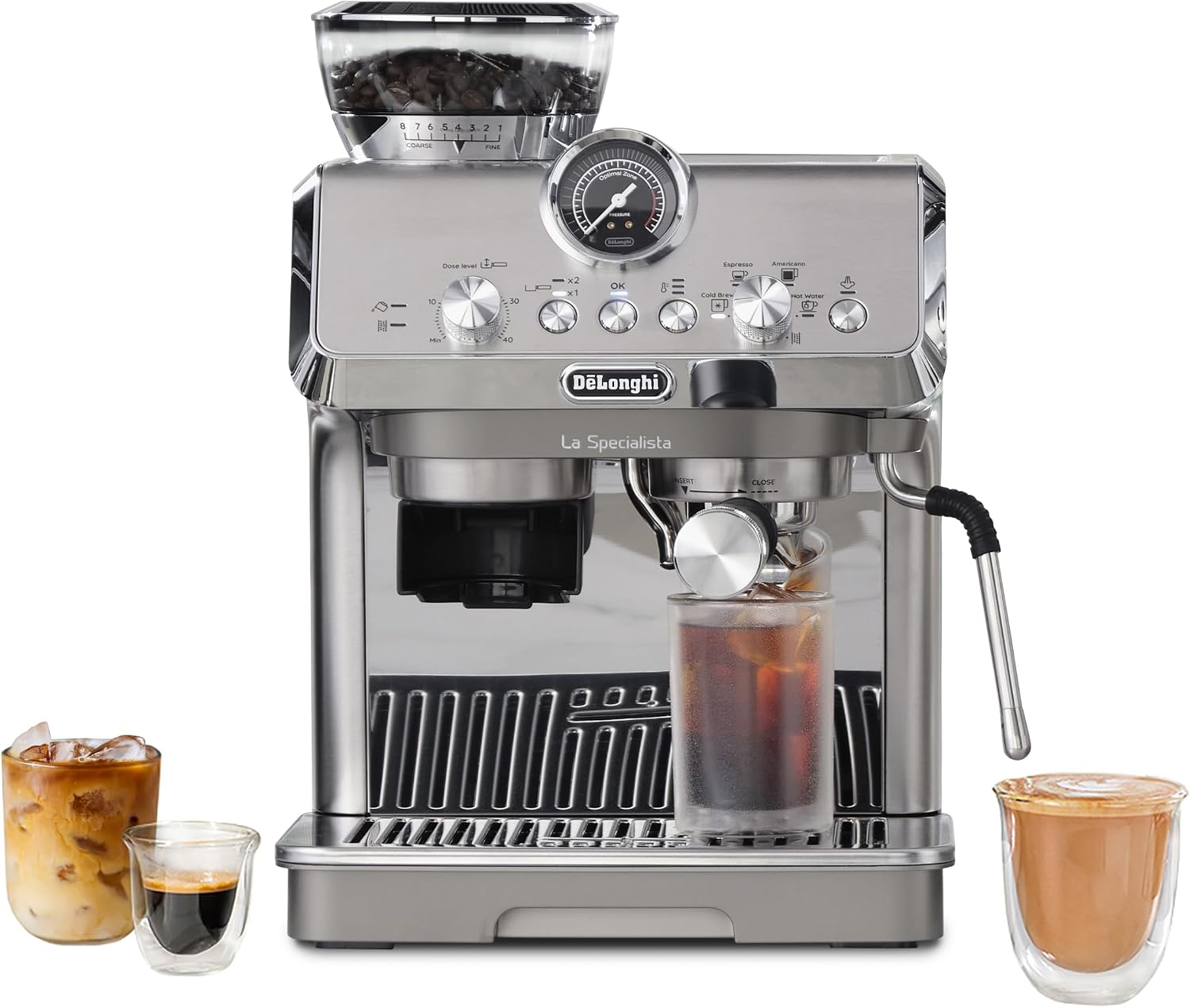
De'Longhi La Specialista Arte Evo Espresso Machine with Coffee Grinder
The only machine here with a burr grinder built in, and the grinder is half the machine
An all-in-one ties your grinder to your machine, so when one half needs service both halves are out of commission
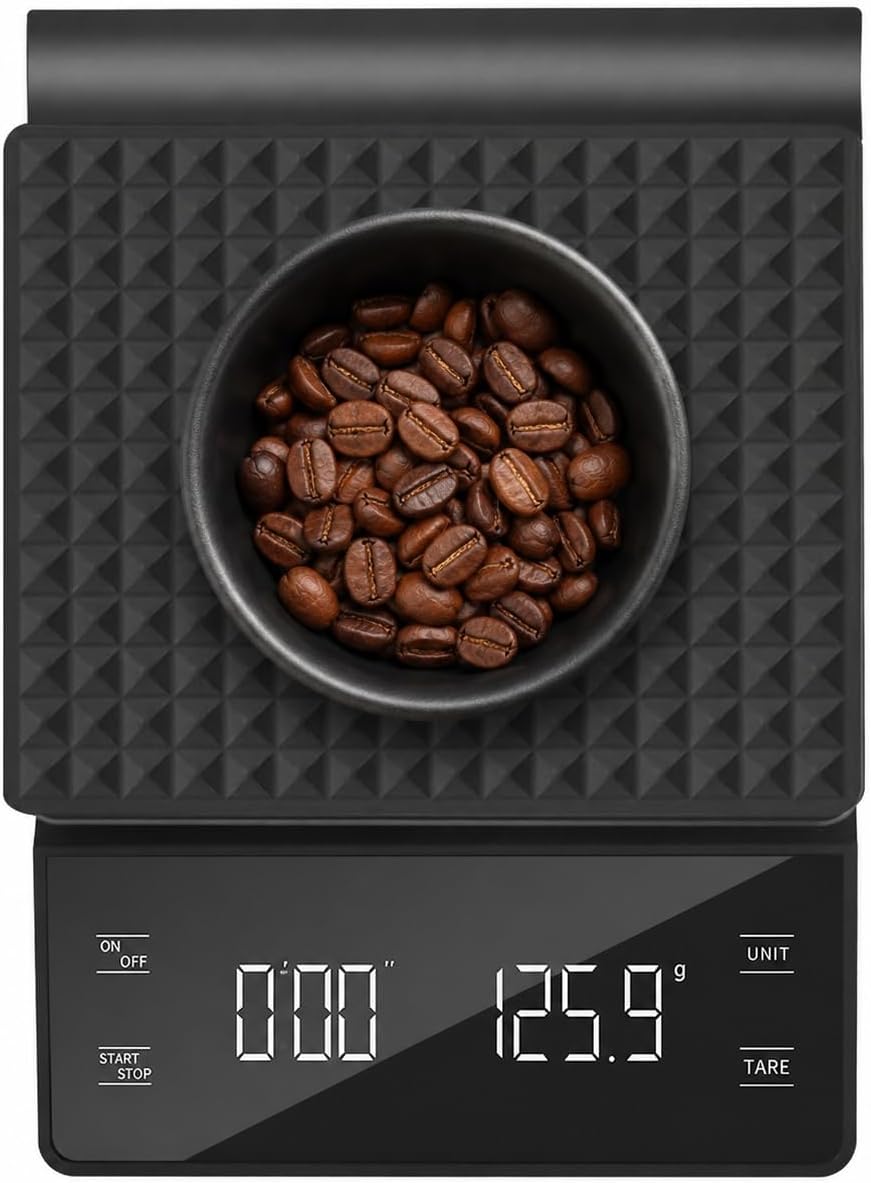
NKOVE Coffee Scale with Timer, 0.1g High Precision Espresso Scale 3kg
0.1 g resolution and a built-in timer is the cheapest route to a repeatable shot
It is a scale. It will not rescue a weak grinder or a pump that cannot reach pressure
Prices and availability were captured from Amazon Creators API and may change.
How I am judging this comparison
An espresso machine is a maintenance contract with a pump attached. So I score these four on five things, in this order: does it build real pressure, does it come with a grinder or need one, how painful is the descale, what breaks first and what does that part cost, and can I see the water level from the front without lifting the tank out. That last one sounds petty until you run a boiler dry, and a dry boiler is how machines die young.
Shot quality is the other half, and shot quality is mostly grind. Weigh your dose, time your shot, stop blaming the machine for a stale bean. A great machine with a weak burr grinder makes sad coffee at any price, which is why the grinder question sits so high on the list.
The all-in-one that actually includes the grinder
The De'Longhi La Specialista Arte Evo is the machine I would tell most people to look at first, and the reason is in the name: it ships with a coffee grinder. That single fact changes the math on the whole purchase. Buy a machine without a grinder and you are either budgeting for a separate burr grinder or buying pre-ground coffee and hoping, and pre-ground espresso is a losing game from the first shot.
What I would check on this one before buying: the grind adjustment range at the fine end, because a grind knob that will not go low enough on the double setting is one of my least favorite things to discover in week two. I would also want to know how the grouphead and the steam wand come apart for cleaning, and whether the drip tray is big enough to get through a latte without a mid-session empty.
The trade-off with any all-in-one is serviceability. When the grinder half wears out or the machine half needs a part, you are not swapping one component, you are sidelining both. That is the price of one plug and one footprint.
The machine that also makes cold brew
The Ninja Luxe Café Pro Series ES701 is the widest brief in this group: espresso, cold brew, and hot water out of one appliance. If your counter is small and your household drinks both hot and iced coffee, that is not a gimmick, that is a genuine argument. Cold brew at home usually means a jar in the fridge and a strainer you have to clean, so having it in the same box as your espresso is worth something real.
The honest caveat is the same one I apply to any machine that promises three jobs. More functions means more cleaning cycles, more seals, and more ways for the thing to be out of commission. I also want to see how the water tank fills and whether the level is visible from the front, because a machine you cannot read is a machine you will run dry.
And yes, I will admit the thing I always admit: a machine with a one-touch mode is going to get used on the mornings you are running late, no matter how much of a purist you claim to be. Convenience is a feature, not a character flaw. It just should not be the only thing you are paying for.
The compact starter, and what 3.5 bar really means
The XIXUBX Compact Espresso & Cappuccino Machine is the smallest and least expensive option here, and it has a steam wand, which is more than a lot of cheap machines manage. If your goal is a small, quick, hot coffee drink with steamed milk in a kitchen with no spare counter, this is the category that fits that job.
But I have to be straight with you about the 3.5 bar figure in its name. Espresso is defined by pressure, and the convention is roughly nine bars at the grouphead. 3.5 bar puts this machine in the same pressure class as steam-driven designs, which means it will not build the pressure needed to pull a genuine espresso shot from a fine, dialed-in grind. What it makes is a strong, concentrated coffee drink with a milk cap, and it can be perfectly enjoyable. It is just a different drink than what a nine-bar machine produces, and no amount of technique will close that gap.
If that trade-off is fine with you, this is the cheapest ticket into the ritual. If you want to learn to dial in a grind and taste the difference, save for one of the machines above. And do not let the water run out, ever. That rule applies at every price.
The scale nobody budgets for
The NKOVE Coffee Scale with Timer is the least glamorous item in this comparison and the one I would buy first. It reads to 0.1 g, handles up to 3 kg, and has a timer, which is everything you need to dose your basket by weight and time the shot. If you have been eyeballing your coffee into the portafilter and guessing when to stop the pump, this is the fix.
Here is why it matters more than it sounds. A repeatable shot is a ratio and a time: a dose you weighed, a yield you weighed, and a window of roughly 25 to 30 seconds. Without a scale you cannot hold any of those three constant, which means you cannot tell whether a change in taste came from your grind, your beans, or your imagination. A scale turns guesswork into a variable you can actually adjust.
It will not fix a bad grinder. It will not add pressure to a 3.5 bar pump. It just makes the machine you already own consistent, which is the cheapest performance upgrade in this entire article.
What breaks first, and what the part costs
On the machines I have owned, the failure order is boring and predictable. O-rings at the grouphead and the portafilter tip go first, and they are cheap. Then a water filter or a descale gets skipped and scale starts doing quiet damage from the inside. Then something electrical or valved fails: on my Breville it was the solenoid, a $20 part that required disconnecting every tube in the machine to reach. I got the machine open, got the tubes off, and got water leaking from all of them, and that is when I stopped.
That story is the reason I ask about part access on any machine before I recommend it. An all-in-one with a built-in grinder has more parts in the same box, so ask how the burrs are replaced and whether the grouphead seal is a user-serviceable item. A machine that cannot be opened is a machine you throw away at year three, and a machine you can open is a machine you keep for nine.
Descale, water filters, and the maintenance contract
Nobody buys an espresso machine planning to descale it, and that is exactly how machines die young. Mineral buildup insulates the heating element, the element works harder, and one morning the machine does not heat at all. If you take one thing from this comparison, take the schedule: water filter every sixty shots or two months, descale on whatever interval your water hardness demands, and a proper cleaning cycle with actual espresso cleaning tablets when the machine asks for it. The clean me light is not a suggestion, it is the machine asking for help.
This is also where a machine's design earns or loses points. A visible water tank, a drip tray you can empty without disassembling anything, and a grouphead you can reach with a brush all make the routine short enough that you will actually do it. The best machine in this comparison is the one whose cleaning routine you will still be following in year three, because that is the version of the purchase that pays for itself.
The trade-offs, laid out plainly
If you want the shortest possible summary of the four: the De'Longhi La Specialista Arte Evo is the one that solves the grinder problem for you, at the cost of tying two appliances together. The Ninja Luxe Café Pro Series ES701 is the one that solves the counter space and cold brew problems, at the cost of complexity. The XIXUBX is the one that solves the budget problem, at the cost of real espresso pressure. The NKOVE scale is the one that solves the consistency problem, at basically no cost at all.
Notice that none of them solve every problem, and any guide that tells you one machine does is selling something. The right question is which problem you have.
Who should buy which
Buy the De'Longhi if you want one purchase that grinds and pulls, you drink mostly milk drinks and straight espresso, and you are willing to learn a grind setting and keep a descale schedule. Buy the Ninja if your household drinks iced coffee and hot coffee and you want one appliance doing the work of three. Buy the XIXUBX if the budget is the hard limit, the counter is tiny, and you want a hot coffee drink with steamed milk without pretending it is a café shot. Buy the NKOVE scale no matter which of the three you pick, because a dose you cannot measure is a shot you cannot repeat.
And if you are still deciding whether espresso is a hobby you want, that is a real question worth answering honestly. A machine that intimidates you into using the drip pot is worse than no machine at all. A modest machine you use every morning beats an expensive one that sits under a cabinet with a dry tank.
What I am testing next
I am working through the same morning routine on the machines that land on my counter: two doubles, one latte, a full clean cycle, and a note on warm-up time, shot consistency, and how annoying the descale actually is. The machines that survive that are the ones that get recommended here, and the ones that buzz and leak get written up as what they are. If you have one of these four and a repair story, I want to hear it, because a $20 part and a Saturday afternoon is often the difference between nine years and eighteen months.