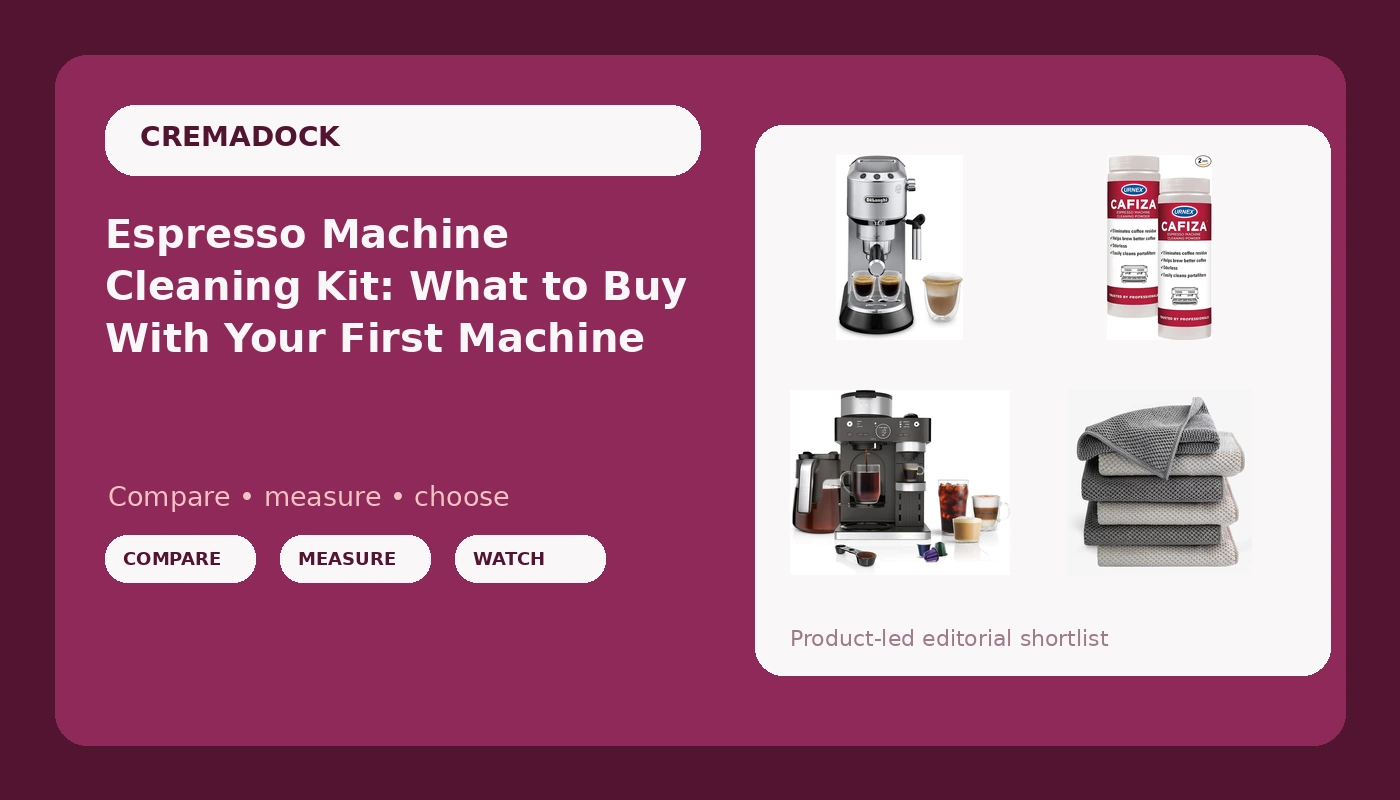
Most people budget carefully for the machine and forget the other half of the purchase. The espresso machine cleaning kit is what decides whether the thing on your counter is still pulling drinkable shots in year three or buzzing and leaking long before you expected to replace it. A home setup is really four decisions stacked together: which machine pulls the shot, how you feed it coffee, what you clean the group head with, and what you wipe the steam wand down with after every milk pitcher. Get the last two wrong and the first two stop mattering. This is a plain look at four products that cover those four jobs, what each one is actually for, and how to tell which combination fits the way you drink coffee.
Related: How to Descale an Espresso Machine Without Killing It →
Quick answer
Pick the machine first, because everything else follows from it. The De'Longhi Dedica Espresso Machine is the fit for a small kitchen that wants to grind, tamp, and pull its own shots with a built-in frother for milk. The Ninja Espresso & Coffee Maker is the fit for a household that wants capsule espresso and a full carafe of coffee without two appliances on the counter. Whichever you choose, the Urnex Cafiza cleaning powder and a pack of barista microfiber towels are the two consumables that keep the group head and the steam wand in working shape, and they are the cheapest part of the whole purchase.
Four useful options
| Model | Best fit | What stands out |
|---|---|---|
| De'Longhi Dedica Espresso Machine, 15-Bar Pump, Frother, Stainless Steel | Small kitchens and a hands-on espresso routine | 15-bar pump, built-in frother, stainless steel housing |
| Ninja Espresso & Coffee Maker, Nespresso Capsule Compatible, Black, CFN601 | Households that want espresso and carafe coffee from one appliance | Two brew styles in one unit, compatible with Nespresso capsules |
| Urnex Cafiza Professional Espresso Machine Cleaning Powder 566 grams (2 Pack) - Made in USA | Routine backflushing and group head cleaning | Two 566 gram containers, made in the USA |
| 6Pack Barista Towels, Barista Microfiber Cloths, 12”x12” | Steam wand, drip tray, and countertop cleanup | Six cloths, 12 by 12 inches each |
The compact machine: De'Longhi Dedica Espresso Machine
The trade-off with a machine in this class is the workflow. A single boiler heats water for the shot and then has to come up to steam temperature for milk, so you pull your shot first and steam second, not both at once. That is fine for one or two drinks. It stops being fine when you are making four lattes for guests and standing there watching a light. The other thing to know is that a manual machine only performs as well as the grinder feeding it. If the budget has to stretch, stretch it toward a burr grinder and let the machine be the simpler part of the setup.
The two-in-one option: Ninja Espresso & Coffee Maker
This is the pick for a household where one person drinks a latte and another drinks a mug of drip coffee at 6 a.m. and neither wants to learn to tamp. What you give up is control: capsules are pre-ground and sealed, so the only variables you own are capsule choice and cup size. There is no puck to diagnose, no grind to dial, and no pressure gauge to read. What you gain is consistency with almost no cleanup routine beyond the capsule bin and a rinse cycle. If you like the idea of learning to pull a shot, this is not that machine, and pretending otherwise leads to a disappointing purchase.
The cleaning powder: Urnex Cafiza
Coffee leaves oils behind on the group head, the portafilter basket, and the shower screen. Those oils go rancid, and a rancid group head makes every shot taste flat and slightly bitter no matter how good the beans are. A backflush cycle with a cleaner like this one is the standard fix, and it is the single maintenance task that separates machines that last from machines that die young. Buy it at the same time as the machine, not the day the indicator light comes on. Read your own machine's manual for the cycle it expects, because backflushing a machine that does not support it is a good way to break something.
The towels: 6Pack Barista Towels
A dedicated steam wand cloth is the smallest upgrade in espresso and one of the most useful. Milk residue bakes onto a wand tip and turns into a crust that is genuinely annoying to remove, and wiping the wand immediately after steaming is the whole prevention strategy. Having six cloths means one lives with the machine for the wand, one handles the drip tray, and the rest go in the wash. It is a small purchase that keeps the rest of the setup from getting grimy.
Prices and availability may change. Product images, names, and retailer links must be matched by verified ASIN. Do not state a current price, rating, stock status, or measured result without current evidence.
Why the cleaning supplies belong in the first order
Espresso is a wet, hot, oily process, and the machine is the thing that absorbs all of it. Three maintenance jobs cover almost everything that goes wrong on a home machine. The first is the daily wand wipe, which takes four seconds and prevents milk crust. The second is the periodic backflush with a cleaner, which strips coffee oils out of the group head and the valve paths behind it. The third is descaling, which removes the mineral scale that builds up inside the boiler and the water paths.
Skipping the first two is what makes a two-year-old machine taste like a five-year-old machine. Skipping descaling is what kills it outright, and the failure is quiet until it is not: flow drops, temperature gets erratic, and eventually the machine stops building pressure at all. If you only do one thing, do the descale on a schedule tied to your water hardness, and use filtered water in the tank if the machine is plumbed to nothing but a pitcher. Never let the tank run dry, because a dry boiler is how machines die young.
Manual machine or capsule machine?
The real fork in the road is whether you want a routine or a button. A manual machine like the Dedica asks you to weigh a dose, grind to the right setting, tamp level, and watch a shot run. That routine is the hobby, and it is also the reason people who love it never go back. A capsule machine asks you to drop in a capsule and press a button, and the Ninja adds a carafe of coffee on top of that. Nothing is wrong with either answer, but they are different purchases with different ongoing costs, and the per-cup math usually favors the manual route once you are past the equipment.
Then there is the grinder question, which is where most first-time buyers get it backwards. A great machine with a blade chopper produces sad coffee, while a modest machine with a real burr grinder can produce shots that embarrass a cafe. If the manual route is your choice, price the grinder before you price the machine. If the capsule route is your choice, the grinder line item disappears entirely.
- Decide how much work you want on a weekday morning. Manual espresso is grind, dose, tamp, pull, purge, wipe, every single time.
- Count your milk drinks. If most of what you drink is milk-based, the frother or steam wand matters more than anything else on the box.
- Check what you already own. A manual machine needs a burr grinder; a capsule machine does not need one at all.
- Budget for the consumables in the same order as the machine: cleaning powder, towels, and descaling solution.
- Ask what breaks first. Group head gaskets, steam wand tips, and water filters are the usual early replacements on any home machine.
Practical guidance
- Buy the cleaning powder and the towels when you buy the machine, so the first cleaning cycle is not a shopping trip.
- Backflush on a regular schedule if you pull shots daily, and follow your machine's manual for the cycle it supports.
- Keep one microfiber cloth for the steam wand only, and rotate the rest for the drip tray and countertop.
- Descale on a schedule set by your water, and use filtered water if you can, because scale is the slow killer.
- Never let the water tank run dry, and pull the drip tray for a rinse before it becomes a project.
Which option should you choose?
Choose the De'Longhi Dedica Espresso Machine when you want to learn the routine, your counter is narrow, and you are willing to pair it with a real burr grinder. Choose the Ninja Espresso & Coffee Maker when your household wants capsule espresso plus carafe coffee and nobody is interested in tamping. Choose the Urnex Cafiza cleaning powder and the 6Pack Barista Towels together when you want the maintenance side handled from day one, which is honestly the right answer for either machine.
The caveat worth stating plainly: the specifications above come from the product names and manufacturer descriptions, not from a measured test bench, and prices and availability change constantly. Nothing here is a claim about how a specific machine performs against another in a side-by-side. The decision that matters most is still whether you will actually clean the machine you buy.
The bottom line
The machine is the visible purchase and the supplies are the invisible one, and the invisible one determines how long the visible one lasts. A compact manual machine and a real grinder reward someone who enjoys the routine. A capsule-and-carafe brewer rewards someone who wants coffee in under a minute with almost no cleanup. Either way, a container of espresso cleaning powder and a stack of microfiber cloths cost less than a couple of bags of beans and prevent the two failures that end most home espresso setups early. Buy them with the machine, not after it starts tasting wrong.