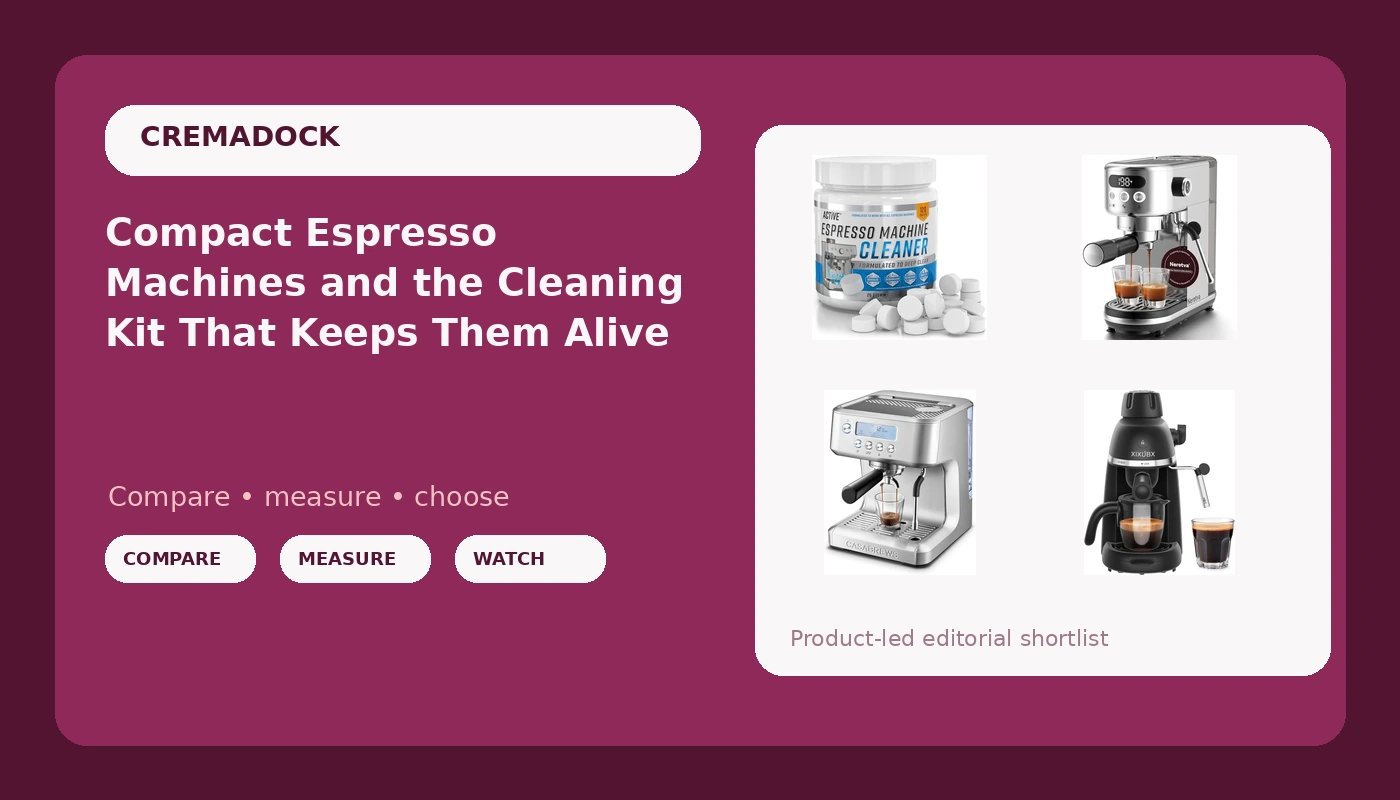
Most people shopping for a compact espresso machine are not really shopping for espresso. They are solving a counter space problem. The machine has to fit between the toaster and the backsplash, heat up before the coffee is ground, and still be worth using on a Tuesday morning when you have four minutes and no patience. That is a different set of requirements from the ones printed on the spec sheet, and it is why the bar rating on the box tells you less than the cleaning routine you are actually willing to keep. This guide walks through three compact machines and the one maintenance product that outlives all of them.
Related: How to Descale an Espresso Machine Without Killing It →
Quick answer
There is no single compact espresso machine that is right for every kitchen, because the three machines here are built for different jobs. The CASABREWS Ultra Espresso Machine is the step-up option, with a steam wand for milk drinks. The Neretva 20 Bar Espresso Machine is the smallest footprint of the group, with a 20 bar pump rating in its listed specification. The XIXUBX Compact Espresso & Cappuccino Machine is the entry point, and its listed 3.5 bar rating puts it in a different category from traditional espresso. Whichever you pick, the ACTIVE Espresso Machine Cleaning Tablets are the purchase that decides how long it lasts.
Four useful options
| Model | Best fit | What stands out |
|---|---|---|
| CASABREWS Ultra Espresso Machine, Barista Espresso Maker with Steam Wand | Someone who drinks lattes and cappuccinos and wants a steam wand | Positioned as the step-up machine of the three, with a barista-style body and steam wand |
| Neretva 20 Bar Espresso Machine Super Compact Espresso Coffee Machine | Very tight counters, straight espresso drinkers | Super compact body with a 20 bar rating in the listed specification |
| XIXUBX Compact Espresso & Cappuccino Machine, 3.5 Bar with Steam Wand | A first machine on the smallest budget | Cappuccino-focused machine with a steam wand, listed at 3.5 bar |
| ACTIVE Espresso Machine Cleaning Tablets Descaling, 120 Tabs | Anyone who already owns an espresso machine | 120 tablets, listed as compatible with Breville Barista Express, Gaggia, DeLonghi, Jura, and Philips |
The step-up pick: CASABREWS Ultra Espresso Machine
A steam wand is the single feature that separates a machine you use for one drink from a machine you use for four. Without one you are drinking espresso and Americanos, which is a perfectly good life, but it is not the reason most people buy a machine in the first place. The trade-off is that a wand adds cleanup. You wipe it immediately after every use, you purge it before you steam, and if you leave dried milk on the tip you will be chipping it off with a pin for the rest of the machine's life. Machines at this level also assume you are supplying your own grinder and your own routine. If the grinder is weak, the wand will not save the cup.
The compact 20 bar option: Neretva 20 Bar Espresso Machine
The 20 bar number is worth reading carefully, and the next section covers why. What matters here is the footprint claim. If your counter is deep enough for a full-size machine, you do not need to pay the compact tax. If it is not, a smaller chassis is not a compromise, it is the only option that survives contact with your kitchen. Note what the listing does not say: there is no steam wand in the product name, so if milk drinks are the point, do not assume one. Verify on the product page before you buy.
The entry point: XIXUBX Compact Espresso & Cappuccino Machine
A 3.5 bar machine is honest about what it is: a steam-pressure brewer, closer in spirit to a moka pot than to the grouphead at your local cafe. The cup is softer and less concentrated, and it is far more forgiving of a mediocre grinder, which is exactly why these machines exist. If you want to know whether you enjoy the ritual of grinding, dosing, and standing at the counter for ten minutes every morning, this is the cheapest way to find out. If you already know you want real espresso, save the money and put it toward a machine that holds proper brew pressure plus a burr grinder.
The maintenance pick: ACTIVE Espresso Machine Cleaning Tablets
Nobody enjoys buying cleaning tablets. Everybody who has watched a machine die at eighteen months wishes they had. At one tablet a week, a 120-count container is a bit over two years of backflushing, which is a strange thing to feel good about until you price a replacement machine. Compatibility is the one thing to check, and this listing names the big ones: Breville Barista Express, Gaggia, DeLonghi, Jura, and Philips. If your machine has a three-way solenoid and a blind basket, it can almost certainly be backflushed. If it does not, tablets still have a role in periodic deep cleaning, but read your manual first.
Prices and availability may change. Product images, names, and retailer links are matched by the listed identifiers. No current price, rating, stock status, or measured result is stated here.
What the bar rating on the box actually means
Bar is a unit of pressure, and espresso is traditionally extracted at roughly nine bar at the puck. A machine advertised as 20 bar uses a vibration pump with a maximum rating well above what the coffee ever sees; the brew pressure at the grouphead is regulated lower, and the number on the box is closer to a pump ceiling than a recipe. That does not make a 20 bar machine bad. It means the number is marketing as much as engineering, and you should not use it to rank two machines against each other.
The 3.5 bar case is different in kind, not just in degree. At that pressure you are not forcing water through a fine, compacted puck the way a nine-bar pump does. Steam pressure builds in a sealed chamber and pushes water through the coffee, which produces a softer, less concentrated cup and behaves much more like a moka pot. Plenty of people drink that happily every morning. Just do not buy it expecting cafe-style shots and then blame the beans.
What actually predicts cup quality at this price level is unglamorous: temperature stability, whether the portafilter takes a real basket, whether that basket is pressurized, and whether you own a burr grinder. A pressurized basket forces coffee through a small opening to manufacture crema, which rescues stale beans but caps how good your shots can get. The moment you switch to a non-pressurized basket, the grinder becomes the limiting factor in the entire setup.
Why cleaning decides how long the machine lives
Backflushing and descaling are two different jobs and people constantly confuse them. Backflushing with a cleaning tablet removes coffee oils and old grounds from the grouphead, the shower screen, and the three-way solenoid. Descaling dissolves the mineral scale that builds up inside the boiler and the water lines. Oils make every shot taste like yesterday's coffee. Scale restricts flow, makes the pump work harder, and eventually blocks the machine or takes the heating element with it.
Most machines with a three-way solenoid can be backflushed in a few minutes: blind basket in, one tablet, run the pump in short cycles, rinse, repeat until the water runs clear. Once a week is a reasonable rhythm if you pull shots daily. Descaling should follow your water hardness rather than your mood. Hard water means descaling more often; filtered water means less scale, not none.
One rule sits above all of this. Do not let the water tank run out. A dry boiler is how machines die young, and it is the only failure mode on this list that is entirely self-inflicted. Buy a machine with a tank you can see the level of from the front, and check it before every session.
- Measure the space first: counter depth, height under the upper cabinets, and clearance for the portafilter handle and the tank lid.
- Decide whether you drink milk drinks. If yes, you need a steam wand, and the Neretva listing does not mention one while the CASABREWS and XIXUBX listings do.
- Check whether you already own a burr grinder. If you do not, that purchase comes before any machine upgrade.
- Read the pressure rating honestly. 20 bar is a pump ceiling, and 3.5 bar is a different brewing method, not a smaller version of the same one.
- Add the maintenance line to the budget. Tablets, water filters, and a descale schedule cost very little next to replacing a machine.
What to check before you commit
- Use filtered water and never let the tank run dry, even once.
- Backflush weekly with a cleaning tablet if your machine has a three-way solenoid.
- Descale on a schedule tied to your water hardness, not to how the espresso tastes.
- Expect the first failure to be a wear part: the group gasket, the portafilter o-rings, or a clogged water filter.
- Buy the machine you will actually clean. A neglected machine at any price makes worse coffee than a cheap one you maintain.
Which option should you choose?
Choose the CASABREWS Ultra Espresso Machine when you drink lattes and cappuccinos regularly and want a steam wand on a machine positioned above the entry tier. Choose the Neretva 20 Bar Espresso Machine when counter space is the binding constraint, you want a 20 bar rating in a super compact body, and you mostly drink straight espresso. Choose the XIXUBX Compact Espresso & Cappuccino Machine when you want the smallest possible commitment to find out whether the ritual sticks, and you accept that a 3.5 bar machine is a different tool from a nine-bar one. Choose the ACTIVE Espresso Machine Cleaning Tablets when you already own a machine with a three-way solenoid and you have not been backflushing it.
This comparison is built from listed product names and specifications, not from bench testing. No warm-up times, shot times, or brew pressures were measured for this article and none are claimed. Pressure ratings and cleaning-tablet compatibility come from the manufacturer listings and should be confirmed on the product page before you buy, since listings and formulations change.
The bottom line
A compact espresso machine is a maintenance contract with a pump attached, and the small machines here make that contract obvious because there is nowhere to hide a neglected grouphead. The CASABREWS Ultra is the one to pick if milk drinks are the point. The Neretva is the one to pick if the counter is genuinely too small for anything else. The XIXUBX is the one to pick if you are not yet sure you want this hobby. And the ACTIVE tablets are the one to pick no matter which machine ends up on your counter, because the difference between a machine that lasts nine years and one that dies at eighteen months is almost never the price you paid. It is whether you cleaned it.