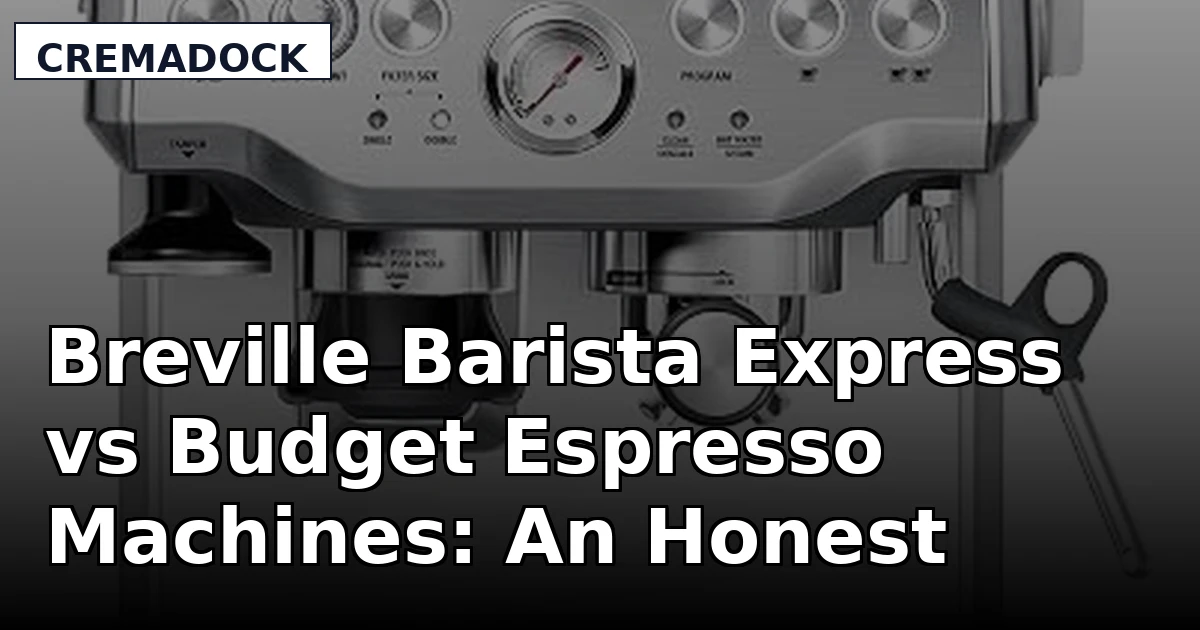
Buying a home espresso machine comes down to one uncomfortable question: will you still be pulling shots on this thing every morning in year three, or will it become an expensive counterweight? The Breville Barista Express is where most people land when they answer that question honestly, because it puts the grinder and the espresso machine in the same box. The two compact machines below sit on the other end of the budget, and the 54mm dosing funnel is the kind of accessory you buy after you have already committed to a Breville-style workflow. What follows is a plain description of what each option is, what it asks of you, and which one fits a real kitchen.
Related: How to Build a Descale Schedule You Will Actually Follow →
Quick answer
For a household that will use the machine daily, the Breville BES870XL Barista Express is the most complete package of the four options here, because it combines a grinder, a 54mm portafilter, and a steam wand in one unit, so you are not shopping for a separate grinder on day one. The AMZCHEF 20 Bar Compact and the Aromaster 1400W with Milk Frother are smaller, lower-cost machines that trade control and build materials for a much lower entry point. The 54mm dosing funnel and puck screen is not a machine at all; it is a workflow accessory for anyone already using a 54mm basket.
4 useful options
| Model | Best fit | What stands out |
|---|---|---|
| Breville BES870XL Barista Express Espresso Machine, Brushed Stainless Steel | A daily routine that includes grinding | Integrated grinder, 54mm portafilter, and steam wand in one unit |
| AMZCHEF 20 Bar Compact Home Espresso Coffee Machine, Matte Silver | Small kitchens and first machines | Compact matte silver body with a 20 bar pump rating |
| Aromaster 1400W Espresso Machine with Milk Frother, Stainless Steel | Budget buyers who want frothing built in | 1400W heating element and an onboard milk frother in stainless steel |
| 54mm Espresso Dosing Funnel & Puck Screen Compatible with Breville Barista | Owners of a 54mm Breville basket | Funnel and puck screen sized specifically for 54mm baskets |
The all-rounder: Breville BES870XL Barista Express Espresso Machine, Brushed Stainless Steel
The trade-off with an all-in-one is that you cannot upgrade one half of it. When the grinder stops keeping up with your palate, you replace the machine or you buy a standalone grinder and leave the built-in one idle. That is not a flaw exactly, it is the nature of the category: you are paying for convenience and a single counter footprint, and the price of that convenience is a shorter upgrade path. The other thing to understand is that a machine with a built-in grinder lives or dies by its cleaning routine. The grinder burrs collect oils, the grouphead collects residue, and the water filter needs replacing on a schedule you set yourself. If you will not do that, the machine will not last, no matter what it cost.
The compact budget pick: AMZCHEF 20 Bar Compact Home Espresso Coffee Machine, Matte Silver
The honest caveat about any machine in this price band is that it does not include a grinder, and the grinder matters more than the machine. A compact budget espresso machine paired with pre-ground supermarket coffee will produce a drink, but it will not produce the shot you are imagining when you buy it. Budget for a burr grinder before you budget for anything else, or accept that you are buying a stepping stone. The second caveat is pressure. A 20 bar pump rating is a pump specification, not a statement about the pressure at the coffee puck, and the two numbers are not the same thing. That distinction is worth understanding before you compare spec sheets, and it is covered further down.
The budget frother pick: Aromaster 1400W Espresso Machine with Milk Frother, Stainless Steel
If most of what you drink is milk-based, a built-in frother removes the part of the learning curve people quit on. Steaming milk on a wand is a skill, and it takes a few weeks of mediocre lattes before it clicks. A frothing device gets you a drinkable latte on day one and never gets better than that. The other thing to weigh is wattage. A 1400W heating element is a statement about how quickly the machine can heat, not about how stable the temperature stays during a shot, and temperature stability is what separates a good shot from a sour or bitter one. Treat the wattage figure as a warm-up convenience, not a quality guarantee.
The workflow accessory: 54mm Espresso Dosing Funnel & Puck Screen Compatible with Breville Barista
This is the item people skip and then wonder why their counter is always gritty. Grinding directly into a 54mm portafilter throws grounds sideways, and every one of those grounds is a small amount of coffee you paid for landing on the counter instead of in the basket. The puck screen does something different: it sits between the coffee and the shower screen, which keeps the grouphead cleaner and reduces how often you have to pull out the cleaning tablets. Neither part makes coffee taste better on its own. They make the routine less annoying, and a routine that is less annoying is a routine you will keep doing.
Prices and availability may change. Product images, names, and retailer links must be matched by verified ASIN. Do not state a current price, rating, stock status, or measured result without current evidence.
What a 20 bar rating actually means at the puck
Espresso is brewed somewhere in the region of nine bar of pressure at the coffee puck. That is the number that matters. The bar figure printed on a machine's box is usually the pump's rated maximum, which is a different measurement taken at a different place in the system. Pumps are frequently rated well above what the brew circuit ever sees, because the machine regulates pressure downstream with an over-pressure valve or a similar mechanism. So a machine advertised at 20 bar is not brewing at 20 bar, and a machine advertised at 15 bar is not necessarily brewing at a lower pressure than the 20 bar one. You cannot rank two machines by that number.
What you can do is look for a pressure gauge, and then learn to read it. A gauge tells you what is happening in real time: if the needle climbs past the usual range and the shot chokes, your grind is too fine or your dose is too high. If it never reaches the range at all, the puck is offering too little resistance and the shot will run fast and taste thin. That is more useful information than any specification line, and it is the reason a gauge is worth more to a beginner than a programmable shot timer.
Dialing in a new machine: the five step routine
Every machine in this guide uses the same underlying method. The variables change, the order does not.
- Weigh your dose. A scale that reads to a tenth of a gram is the cheapest upgrade in espresso. Guesswork at the grinder is where most bad shots start.
- Set the grind, then adjust. Start coarser than you think you need, then go finer in small steps. Big jumps make it impossible to tell which change did what.
- Time the shot. Start counting when the pump starts. A shot that finishes in twelve seconds is running fast; one that never finishes is choked. Aim for consistency before you aim for a target time.
- Taste and adjust one variable. Sour and thin usually means grind finer or dose higher. Bitter and harsh usually means the opposite. Change one thing, then taste again.
- Clean before you change anything else. A dirty grouphead and a stale puck taste like yesterday. Wipe, flush, and pull again before you blame the grinder.
Keeping a budget machine alive
- Never let the water tank run dry. A dry boiler is how machines die young, and it is the most common way a cheap machine becomes a dead machine.
- Descale on a schedule, not on a feeling. Mineral buildup kills machines from the inside, slowly, and by the time you notice a taste change it has been happening for months.
- Use the cleaning cycle the machine offers. If it has a clean-me indicator, treat it as the machine asking for help rather than a suggestion.
- Replace water filters on a count, not a calendar you forget. Filter life is usually tracked in uses, and a spent filter stops doing anything at all.
- Empty the drip tray before it overflows. Small trays fill fast, and standing water under the machine is how the base starts corroding.
Which option should you choose?
Choose the Breville BES870XL Barista Express when you want one purchase that covers grinding, brewing, and steaming, and you are willing to clean it on a schedule. Choose the AMZCHEF 20 Bar Compact Home Espresso Coffee Machine when counter space is the binding constraint and you plan to pair it with a separate burr grinder. Choose the Aromaster 1400W Espresso Machine with Milk Frother when milk drinks are the point and you want the frothing handled without learning wand technique first. Add the 54mm Espresso Dosing Funnel & Puck Screen if you already own a 54mm Breville basket, since it only fits that size.
One caveat on all of this: these are descriptions of what each product is, drawn from the manufacturer's own naming and stated specifications. They are not test results. Warm-up behavior, shot consistency, steam power, and how each machine holds temperature over a session are things you learn by running the same coffee through them for weeks, and no spec sheet substitutes for that. Read the negative reviews on purpose before you spend anything, and pay attention to the ones written after a year of ownership rather than the ones written the day the box arrived.
The bottom line
The Breville BES870XL Barista Express is the option here that removes the most decisions from your morning, because the grinder, the portafilter, and the steam wand are already in one place. The AMZCHEF and the Aromaster are entry points, and entry points are fine as long as you go in knowing they are entry points and that the grinder is a separate purchase you should not skip. The dosing funnel and puck screen are a small add-on that makes an existing 54mm setup tidier to use.
Whichever way you go, the deciding factor is not the machine. It is whether you will keep the water tank full, run the cleaning cycle, and descale on schedule. A machine you maintain will outlast one that cost three times as much and never got cleaned.