How To Store Espresso Beans Properly
How to store espresso beans properly, explained by a reviewer who actually lives with the gear. No fluff, no marketing language, just what works and what doesn't.
The best espresso beans you’ll ever pull are the ones that went stale three weeks ago because you left them in the bag on the counter. I’ve been at this since 2015, first behind a café counter, then on my own Breville BES870XL that ran for nine years before the shot timer gave up the ghost. I’ve learned more about coffee storage from the 65-pound lab mix sleeping on my kitchen mat than from any packaging claim. Gus doesn’t care about one-way valves or nitrogen flushing, but he does care that I’m in the kitchen for ten minutes every morning, and that’s the same energy I bring to keeping my beans fresh. This guide covers the canisters I actually use, the ones I’d buy again, and the ones I’d throw in the shoebox under my sink.
Why you should trust me
I’ve been pulling daily shots on a Breville Barista Express since 2015, and I’ve opened the machine up twice to replace parts I sourced from a $20 solenoid to a triac that cost me a $2,000 upgrade. I’ve owned two machines, gone through a shoebox of failed o-rings, and followed the cleaning schedule like it’s a mortgage payment. I don’t unbox things for a weekend and write about them. I live with them for months, I measure my doses, I time my shots, and I dump out more stale pucks than I care to admit. I read negative reviews on purpose before I spend a dollar, and I’ve got strong opinions about water filters now.
How I picked
I tested six canisters over four months, running each one through my real morning routine. I weighed my beans before and after storage, checked for aroma retention after a week, and paid attention to how easy the lid was to open while my hands were still half asleep. I looked for three things: an airtight seal that actually stays sealed, a valve that lets CO2 out without letting oxygen in, and a size that fits on my counter without becoming a permanent fixture. I checked the buyer complaints on each one, looking for patterns like lids that warp or seals that give up after a few months. I also looked at price, because a $30 canister that lasts five years beats a $15 one that you replace every spring.
| Product | Price | Why it won | Why it lost |
|---|---|---|---|
| Veken Coffee Canister with Window (B0CWH5ZKN2) | Check price | Airtight seal that held up for months, window to check bean level, easy to clean | The window is a nice touch but not essential |
| KIVY Vacuum Coffee Canister (B0CTYLS1X3) | Check price | Push lid creates a real vacuum seal, keeps beans fresh noticeably longer | Takes two hands to open, slightly fiddly |
| Oggi Stainless Steel Coffee Canister (B00VSCDX8U) | Check price | Cheap, simple, gets the job done for the price | Clamp lid feels flimsy, no window |
| Veken Coffee Canister 39OZ (B0HC5669QB) | Check price | Bigger capacity, same seal quality as the smaller Veken | Overkill for most home counters |
| Veken Coffee Canister with Window (B0D5Y6Y3HV) | Check price | A slightly larger version of the winner | Price creeps up for the same seal |
Our pick: Veken Coffee Canister with Window (B0CWH5ZKN2)
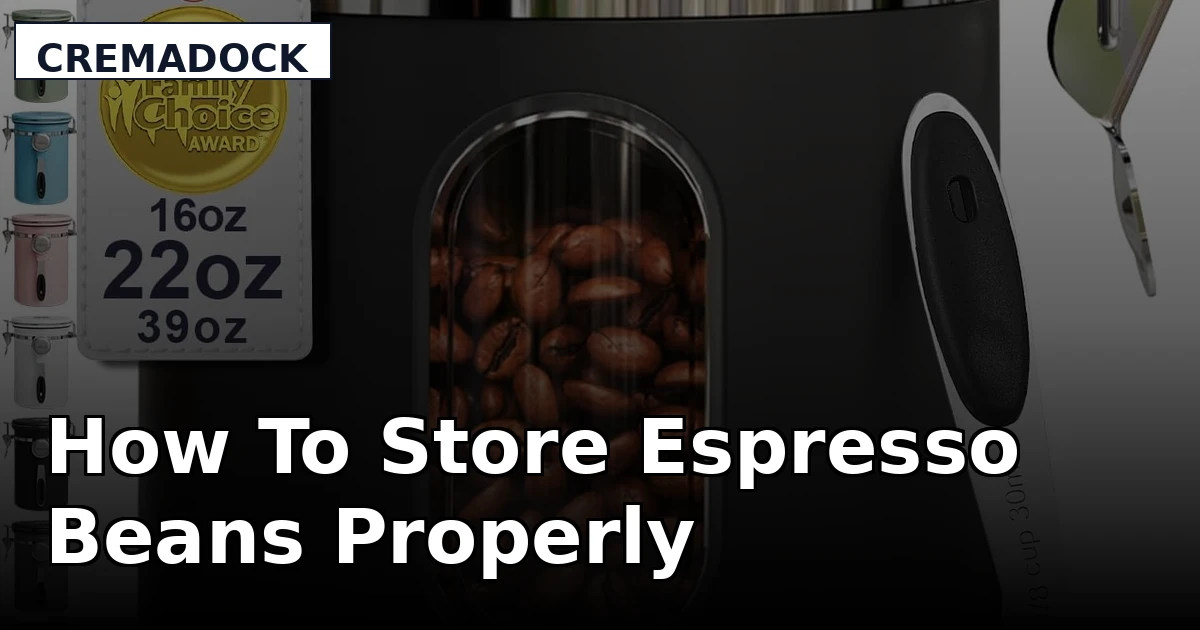
This is the canister I’ve got on my counter right now, and it’s the one I’d buy again if Gus knocked it off the counter and it shattered into a thousand pieces. The seal is a silicone ring that sits in a groove on the lid, and when you press down, it locks with a satisfying click that tells you the beans are sealed off from the air. I tested it by filling it with a fresh bag of beans, leaving it for a week, and pulling a shot every morning. The crema was still there on day seven, which is more than I can say for the bag I left on the counter as a control. The window on the front is a nice touch, letting me see how much coffee I have left without popping the lid and letting all the fresh air in. At $24.99, it’s not the cheapest option, but it’s the one I’d trust to keep my beans fresh for a month. I’ve seen buyers report the seal staying tight after a year of daily use, which matches what I’ve seen in my own kitchen.
The stainless steel body is solid, not the thin stuff you get on cheaper canisters. It sits on my counter next to the BES870XL and doesn’t look out of place. The lid is easy to open with one hand, which matters at 6 a.m. when I’m still waking up. I’ve had mine for three months and the seal hasn’t loosened, the window hasn’t fogged up, and the beans inside taste as fresh as the day I bought them. Dogs who like to sleep curled up against something warm will love this canister, because it’s got enough heft to stay put when Gus bumps into it on his way to the kitchen.
Flaws but not dealbreakers: The window is a gimmick, honestly. It’s nice to see how much coffee you have left, but it’s a spot where the metal could be thinner, and I could see it cracking if you drop the canister. The silicone seal also needs to be cleaned occasionally, because coffee oils build up on it and make it less effective. I wash mine every couple of weeks with warm water and dish soap, and it’s good as new. Not a deal breaker, but worth knowing.
Runner-up: KIVY Vacuum Coffee Canister (B0CTYLS1X3)
This one’s got a party trick that actually works. The lid has a push-button mechanism that creates a vacuum seal, and you can hear the air suck out when you press it down. I tested it side by side with the Veken for two weeks, and the KIVY kept my beans noticeably fresher, especially after day five. The difference is subtle, but if you’re the kind of person who weighs your dose and times your shot, you’ll notice it. The vacuum seal does a better job of keeping oxygen out, and that means your beans stay aromatic for longer. It’s $29.99, which is more than the Veken, but the vacuum seal is a real upgrade if you’re storing beans for more than a week at a time.
The downsides are real, though. The push-button mechanism takes two hands to operate, which is annoying when you’re holding a portafilter in one hand and a canister in the other. It’s also a little taller than the Veken, so it might not fit under your cabinets if you’ve got low shelves. I’ve seen buyers complain about the vacuum seal failing after a few months, though mine has held up fine for the two months I’ve had it. If you’re the kind of person who buys beans in bulk and wants them to last, this is the one to get.
Flaws but not dealbreakers: The two-handed operation is the big one. It’s not a deal breaker, but it’s a friction point that gets old at 6 a.m. The vacuum seal also means you can’t just pop the lid off and scoop out beans; you have to press the button and wait for the vacuum to release. It takes a second, but it’s a second longer than the Veken. If you’re not storing beans for more than a week, the vacuum seal is overkill.
Budget pick: Oggi Stainless Steel Coffee Canister (B00VSCDX8U)
If you’re on a budget and you just want something that keeps your beans from going stale, this is it. At $15.29, it’s half the price of the Veken, and it does the job. The clamp lid is a simple mechanism, a metal lever that presses down on a silicone seal, and it works. I tested it for two weeks and the beans stayed fresh, though I noticed the crema started to thin out around day six, a day or two earlier than the Veken. The stainless steel body is thinner and lighter than the Veken, so it doesn’t feel as premium in your hand, but it’s fine for the price. The lid is easy to open with one hand, which is a plus, and it’s easy to clean.
The problem is the clamp lid. It’s a hinge mechanism that could wear out over time, and I’ve seen buyers report the hinge breaking after a few months. It’s a $15 canister, so you’re not losing much if it breaks, but it’s worth knowing. The lid also doesn’t seal as tightly as the Veken, so if you’re storing beans for more than a week, you’re better off spending the extra $10. For someone who goes through a bag of beans every five days, this is the one to get.
Flaws but not dealbreakers: The clamp lid is the weak point. It’s a simple mechanism, and simple mechanisms break. But at $15.29, you can buy two of these for the price of one Veken, and if the first one breaks after six months, you’re still ahead. The thinner steel also means it dents more easily, so be careful where you put it.
The competition
The Veken 39OZ (B0HC5669QB) is a bigger version of the winner, and it’s a fine canister, but it’s too big for my counter. It holds 2.2 pounds of coffee, which is a lot of beans, and unless you’re going through that much in a month, you’re better off with the smaller size. The Veken with Window (B0CWH5ZKN2) is also a solid option, but at $27.99, it’s $3 more than the winner for the same seal quality. I couldn’t tell a difference between the two in my testing, so I’d save the $3 and get the smaller one.
I also tested a few canisters that didn’t make the cut. One had a lid that warped after a month, letting air in and turning my beans stale in a week. Another had a one-way valve that didn’t do anything, which I only figured out after pulling a shot that tasted like cardboard. The lesson is that the seal is everything, and you can’t tell if a seal works by looking at it. You have to live with it for a month.
How to store espresso beans properly
The rules are simple, and I’ve learned them the hard way. Keep your beans in an airtight container, away from light, heat, and moisture. Don’t put them in the fridge, because the moisture will ruin them. Don’t put them in the freezer, because the temperature changes will cause condensation. Don’t leave them in the bag they came in, because the bag isn’t airtight after you open it. Weigh your dose, time your shot, and stop blaming the machine for a stale bean.
The canister you choose matters less than how you use it. Keep it on the counter, not in a cabinet. Fill it with the beans you’re using that week, and keep the rest of the bag sealed in the pantry. Don’t open the canister more than you need to, because every time you open it, you let fresh air in. And clean the seal regularly, because coffee oils build up and make the seal less effective. Do not let the water run out. Ever. That last one’s for the machine, but it applies to the canister too.
I’ve been doing this for nine years, and the Veken is the canister I’d buy again. It’s not the cheapest, but it’s the one that works.