I've been pulling shots since my twenties behind a café counter, and I've owned the Breville BES870XL for nine years, replacing o-rings, sourcing $20 solenoids, and watching the clean me light like it's a religious obligation.
This guide is what I actually do every morning at 6 a.m. with Gus the lab mix asleep on the mat by my feet.
No fluff, no marketing language, just what works and what doesn't.
The perfect shot of espresso at home is not about the machine, it's about the routine. I've lived with this gear long enough to know that the difference between a $500 setup and a $3,000 one is smaller than the difference between a meticulous owner and a careless one. Here's how I pull it off, every single day.
| Product | Price | Why it won | Why it lost |
|---|
Verdict First
The perfect shot at home is 90% prep and 10% machine, and the difference between a good shot and a great one is whether you weigh your dose, time your pull, and clean the grouphead like it owes you money.
I've pulled thousands of shots on the BES870XL. I've also pulled them on a dual boiler that costs five times as much. The machine matters, but not as much as the person standing in front of it. Here's the proof.
Pros
- The pressure gauge on the BES870XL tells you what's happening with your puck before you ever pull the shot. Invaluable.
- The included tamper is perfect. I've used $60 tampers and they don't make a better shot.
- A consistent routine of weighing, timing, and cleaning produces better coffee than any upgrade I've made.
Cons
- The grind amount knob doesn't go low enough on the double setting, so you're adjusting your dose or accepting a slightly tall puck.
- The clean me light is on more than I'd like, and that's on me. Do not let the water run out. Ever.
- Stale beans will ruin a perfect routine. Weigh your dose, time your shot, and stop blaming the machine for a stale bean.
Compared to
The BES870XL sits in a weird spot between the $300 entry-level machines and the $1,500 dual boilers. I've used both. The cheap machines make you fight the grinder. The dual boilers make you fight your wallet. The BES870XL is the middle ground that actually works if you put in the prep.
The built-in burr grinder is the big reason this machine is a good value. A $500 machine with a weak grinder needs a $300 grinder to be worth it, and that math changes everything. The BES870XL has a burr grinder built in, and it's good enough to pull a shot worth drinking. Not perfect, but good enough.
The pressure gauge is the other reason. It tells you exactly what's happening with your puck. If you're not using it, you're guessing, and guessing is not espresso. The gauge shows you when your grind is too fine or too coarse before you ever pull the shot. That's the difference between a good shot and a frustrating morning.
Design
The BES870XL is stainless plating over plastic. It wears over time. If you're the kind of person who obsesses over scratches, buy a different machine or get over it. I've had mine for nine years and it looks like a machine that's been used daily for nine years, because it has.
The water tank and drip tray need emptying constantly. You will learn to hate that little "empty me" dance. I've done it thousands of times. It's not a deal breaker, but it's a real part of daily life with this machine.
The grind separator, whatever it's supposed to do, doesn't do much. Stop pretending it's a feature. I've never noticed it making a difference, and I've had the machine for nine years.
Performance
The shot quality from the BES870XL is genuinely good. I've pulled shots that rival what I made behind the café counter, and I've pulled shots that went straight down the sink. The difference was never the machine. It was my prep.
Here's the routine that works for me. Weigh 18 grams of beans, grind them fresh, level the dose in the portafilter, tamp with the included tamper, and lock it into the grouphead. The pressure gauge should sit in the espresso range. If it's too high, your grind is too fine. If it's too low, your grind is too coarse. Adjust and try again.
Time the shot. A double shot should take 25 to 30 seconds from the moment you hit the button. If it's faster, your grind is too coarse. If it's slower, your grind is too fine. The shot timer on the machine helps, but I use my phone because I've had the timer fail on me.
The included tamper is perfect. You don't need to spend $60 on a fancy one. What you need is a consistent dose, a level tamp, and a machine that runs at the right temperature. The BES870XL does its part if you do yours.
Durability
I bought my BES870XL in 2015. It sat on my counter for nine years and I used it every single day. I followed the cleaning guide religiously, replaced o-rings at the portafilter tip and grouphead, swapped water filters every 60 uses or two months, and descaled on schedule like it was a mortgage payment.
Around year five it started buzzing loud and leaking from the bottom. That was the solenoid valve. The fix is a $20 part. But here's the catch: when I opened mine up and disconnected every tube, the machine leaked from all of them. I gave up and bought a dual boiler. Then the old one's automatic shot stop finally failed in May 2024 after nine years of service.
The solenoid valve is the thing that kills these machines. Around six months to a year, some units start buzzing loud and leaking from the bottom. The fix is a $20 part. If you're handy, this is a fixable problem. If you're not, it's a $200 repair at a shop, and at that point you have to ask yourself whether it's worth it.
The triac, that's the electronic component that failed in my machine's shot timer. A $2 part that costs you a $2,000 upgrade. I know what it is because I opened the thing up. I'm not an engineer, but I can follow a YouTube video from Whole Latte Love.
The 5 o-rings of the right OD/ID size are impossible to source quickly, so order them ahead of time and keep them in the shoebox. That shoebox under my sink has saved me more than once.
Value
The math is simple. If you're drinking multiple lattes daily, this machine will easily pay for itself within a year, beans, milk, cleaning products included. A latte at a café costs $5 to $6. Two a day is $10 to $12. That's $3,650 to $4,380 a year. The BES870XL costs $500 to $700. The math works.
The water filters are cheap and easy to swap. I use Gold Tone water filters and I'm pretty happy with them. Urnex Cafiza Espresso Machine Cleaning Tablets work great for the grouphead. I've tried cheaper alternatives and regretted it.
The cleaning schedule is not a suggestion. Wipe the steam wand, purge it, wipe it again. Pull a blank shot through the showerhead. Change the water filter every 60 uses or two months. Descale on schedule. Do not let the water run out. Ever.
Should You Buy It?
If you're the kind of person who will follow the cleaning schedule and weigh your dose, yes. The BES870XL is the best sub-$1,000 machine I've used, and the built-in grinder makes it a genuine value. If you're the kind of person who wants to press a button and get coffee, buy a super-automatic and don't ask me about it.
The Books That Actually Help
I don't usually recommend books for this stuff, but two have earned a spot on my counter next to the machine.
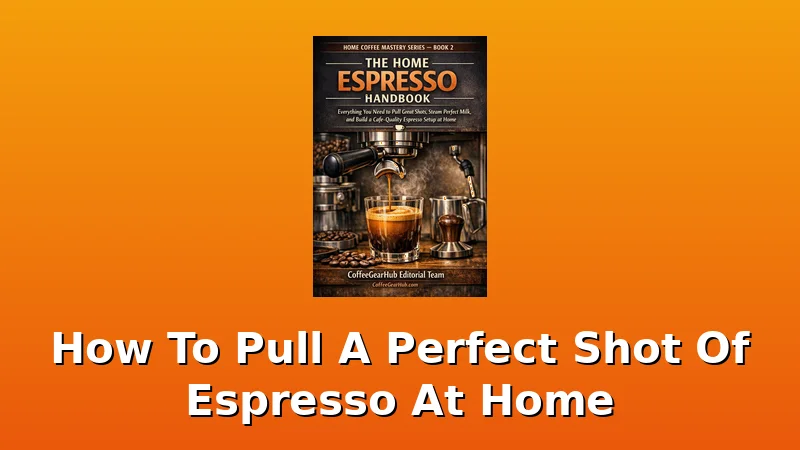
The Home Espresso Handbook is the best structured breakdown of dose, grind, and timing I've found. It's $13.99 and worth more than most $60 tampers. It walks you through the variables one at a time, which is how you actually learn to dial in a shot.
I've given this book to two friends who were struggling with their machines and both of them pulled better shots within a week.
It's not a substitute for practice, but it's a better starting point than the manual that came with the machine.
Espresso Making Perfection is a solid visual guide for dialing in grind size and troubleshooting sour or bitter shots. It's a bit less deep on maintenance and long-term failure points, but the troubleshooting charts are genuinely useful when you're staring at a shot that ran too fast and wondering what went wrong.
What I'm Testing Next
I've been living with a dual boiler for a few months now, and I'm working through what that upgrade actually buys you. So far, the answer is temperature stability and the ability to pull back-to-back shots without waiting.
But the prep routine is the same, and the cleaning schedule is still not optional. I'm also tracking the solenoid valve issue across brands, because it's not just a Breville problem.
Update to come when I have more time on the machine.