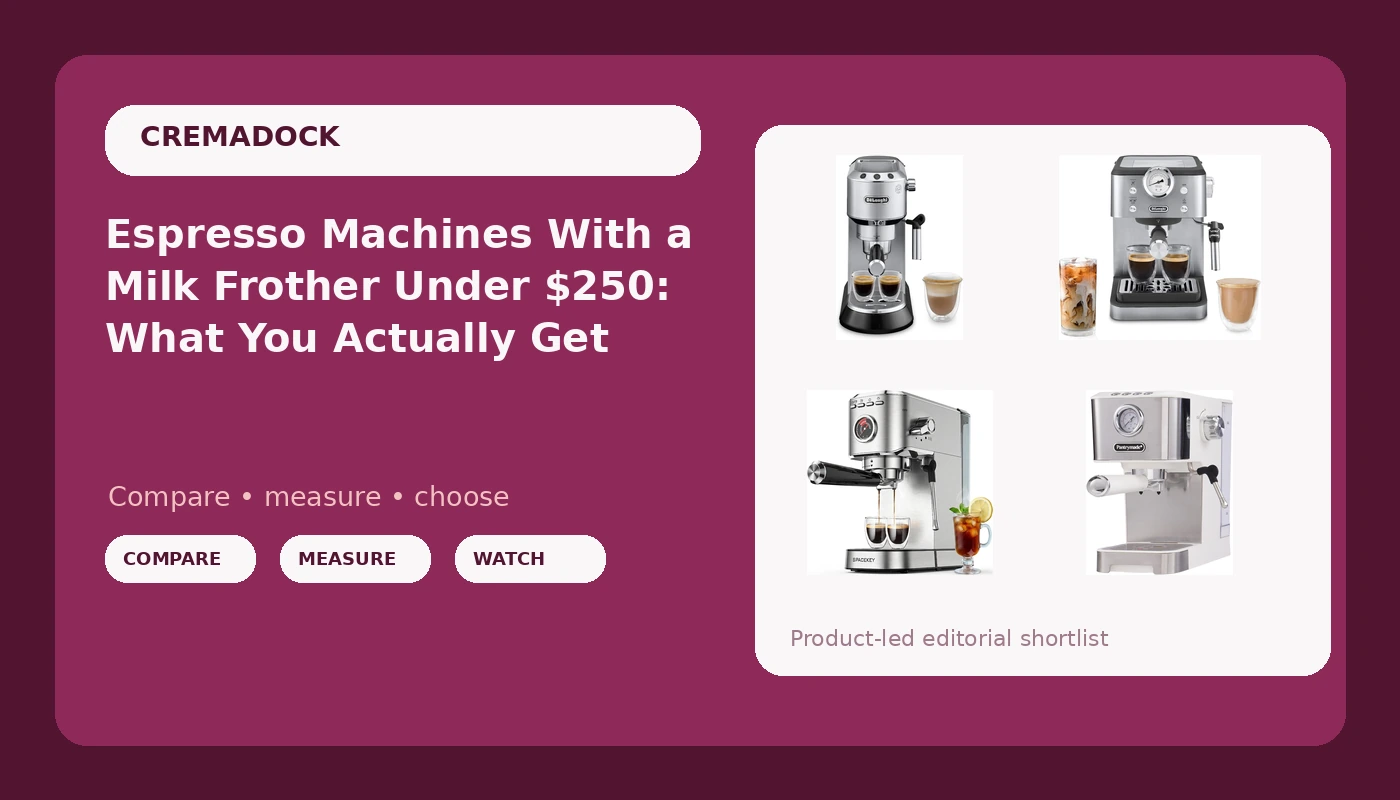
Buying an espresso machine with milk frother under $250 is really a budgeting exercise wearing a stainless steel costume. The machine is one line item. A burr grinder, fresh beans, a scale, a milk pitcher, and descaling solution are the rest of the receipt, and if the entire budget goes into the box with the steam wand, you will spend the next month pulling thin, gushing shots and blaming the machine for a problem that started at the grinder.
This page covers four pump-driven machines that sit in roughly the same price neighborhood and solve different problems: a compact 20 bar model with a 39 ounce removable water tank, a 20 bar machine with a pressure gauge on the front, the narrow De'Longhi Dedica with a 15 bar pump, and De'Longhi's Classic Signature model with an adjustable frother. None of the four includes a grinder. All four can produce a respectable cappuccino or latte if you handle the puck and the milk correctly. The differences that actually matter day to day are footprint, water capacity, whether you can see what the pump is doing, and how much control the frother gives you.
Related: How to Descale an Espresso Machine Without Killing It →
Quick answer
At this price, every machine here runs a vibration pump and a steam frother, so the question is which compromise you can live with. If counter space and total spend are the hard limits, the Spacekey model is the smallest commitment. If you want feedback while you dial in a grind, the Pantrymade is the only one of the four whose listing includes a pressure gauge. If you want the narrowest, longest-running platform with a deep owner community behind it, the De'Longhi Dedica is the familiar answer. If you want an adjustable frother and the step-up build at the top of this group, the De'Longhi Classic Signature is the one to look at. Whatever you choose, plan the grinder in the same year.
Four useful options
| Model | Best fit | What stands out |
|---|---|---|
| Spacekey Espresso Machine with Milk Frother | Very small counters and first-time buyers | 20 bar pump, 39oz removable water tank, compact stainless steel body |
| Pantrymade 20 Bar Espresso Machine with Milk Frother and Pressure Gauge | Anyone learning to dial in a grind | Built-in pressure gauge plus a 20 bar pump and frother |
| De'Longhi Dedica Espresso Machine, 15-Bar Pump, Frother, Stainless Steel | Narrow spaces and buyers who want a proven name | 15 bar pump and frother in a slim stainless steel body |
| De'Longhi Classic Signature Espresso Machine, Adjustable Milk Frother | Buyers who want more frother control | Adjustable milk frother from a long-established brand |
The lowest-cost start: Spacekey Espresso Machine with Milk Frother
The pitch here is space and money. A 39 ounce tank is generous for a machine this small, which means fewer refills during a two-latte morning, and a removable tank is the difference between rinsing it in the sink and wiping it out with a sponge on your knees. The trade-offs are the usual ones at the entry point: lighter construction, a housing that will not feel like a commercial machine, and a frother that rewards technique more than it rewards button pressing. Budget for a descale bottle at the same time you buy the machine, because the smaller the boiler, the less it enjoys mineral buildup.
The one with a gauge: Pantrymade 20 Bar Espresso Machine with Milk Frother and Pressure Gauge
A pressure gauge is the most useful thing a beginner can have on the front of a machine, and it is rare at this price. It tells you what the pump is doing while you change grind, dose, and tamp, which shortens the guessing game considerably. Read it as a trend, not a verdict: if the needle climbs into the same range every time you get a good shot, you have learned something about your grinder that no review could have told you. The rest of the package is a standard 20 bar pump and steam frother, so the gauge is the reason to pick this one over the cheaper compact.
The narrow classic: De'Longhi Dedica Espresso Machine, 15-Bar Pump, Frother, Stainless Steel
Do not read 15 bar as a downgrade from 20 bar. The pump rating is a maximum, not a recipe, and this is the machine in the group with the longest track record behind it. The Dedica's value is that it fits where other machines will not, heats quickly, and has years of owner threads, cleaning walkthroughs, and accessory advice floating around, which matters more than any single spec when something eventually needs attention. It is also the machine most likely to make you want a real burr grinder immediately, because a narrow machine with a decent pump will expose a blade grinder in one shot.
The step up: De'Longhi Classic Signature Espresso Machine, Adjustable Milk Frother
Adjustable is the word that justifies the price gap. A frother you can tune gives you a range between a thin, drinkable microfoam for a flat white and a stiff, dry foam for a cappuccino, and it lets you correct for the milk you actually buy rather than the milk the manual assumes. What you are also paying for is De'Longhi's service footprint and a machine that feels more substantial on the counter. What you are not getting is a grinder, a scale, or any escape from descaling. Treat the extra spend as convenience and control, not as a shortcut to better espresso.
Prices and availability change. Product images, names, and retailer links are matched by product identifier. This page does not state a current price, rating, stock status, or measured result.
What 15 bar and 20 bar actually mean
A pump rating describes the maximum pressure a pump can produce, not the pressure your coffee sees. Real espresso extraction happens in the neighborhood of nine bars at the puck, and every one of these machines regulates or bypasses pressure somewhere between the pump and the grouphead. That is why a 15 bar machine and a 20 bar machine can produce similar shots, and why the number on the box is a poor way to rank them.
What matters more is consistency. Can the machine hold pressure through a 25 to 30 second shot without choking or gushing? Does it recover quickly enough to pull a second double back to back? Can you control dose and grind finely enough to hit that window in the first place? That last part is on your grinder, not the machine. A 20 bar pump paired with a blade grinder produces worse espresso than a 15 bar pump paired with a real burr grinder, every time, because the puck is where the flavor is decided.
This is also where the pressure gauge on the Pantrymade earns its place. If the needle moves into the same zone on your good shots and a different zone on your bad ones, you have a live readout of your own technique. Learn to read it and you will stop changing three variables at once.
How milk frothers differ
Most machines at this price use a steam wand, and "frother" is the marketing word for it. Some wands are bare metal tips you submerge and control by hand. Others wear a sleeve that pulls in air for you, which is more forgiving but less precise. An adjustable frother sits in between: you change how much air gets introduced, so you can move between glossy microfoam and thicker foam without swapping parts.
Technique beats hardware either way. Start with cold milk, submerge the tip just below the surface, and let air in for the first few seconds. Then push the wand deeper so the milk rolls in a vortex instead of screaming. Stop when the pitcher is warm to the touch, not hot. Wipe the wand and purge it immediately after every use, because dried milk on a steam tip is the single most common reason a frother starts performing badly. Whole milk foams most easily, oat milk works well if you use a barista version, and skim milk will fight you.
- Measure the counter and the clearance under your upper cabinets before you compare anything else, because a machine that does not fit is not a candidate.
- Decide whether a burr grinder is coming in the same year. If it is not, buy the cheapest machine here and put the difference toward the grinder.
- Look at the water tank from where you will actually stand. A tank you cannot see from the front is a tank you will run dry.
- Decide how much frother control you need. Occasional lattes are fine with a fixed wand; daily milk drinks make an adjustable frother worth considering.
- Read the descaling instructions before you buy, not after. If the process sounds like something you will put off, buy the machine with the simplest routine and the cheapest parts.
Practical guidance
- Use filtered water. It is cheaper than a new boiler and it slows the scale that kills small machines.
- Never let the water run dry. A dry boiler is how a working machine becomes a repair project.
- Descale on the schedule in the manual, and keep the solution on the shelf where you will see it.
- Clean the grouphead and the portafilter basket regularly. Old coffee oil makes every shot taste like yesterday.
- Weigh your dose and time your shot. Two numbers turn espresso from a mood into a repeatable process.
- Buy fresh beans with a roast date, not a best-by date, and store them away from light and air.
Which option should you choose?
Choose the Spacekey Espresso Machine with Milk Frother, 20 Bar Compact Expresso Coffee Machines for Home, Stainless Steel Espresso Maker with 39oz Removable Water Tank for Cappuccino Latte, Fast Heating, Silver when the counter is tiny, the budget is tight, and you want a removable tank big enough to get through a morning without refilling. Choose the Pantrymade 20 Bar Espresso Machine with Milk Frother and Pressure Gauge when you are still learning and you want the machine to tell you what your grind is doing. Choose the De'Longhi Dedica Espresso Machine, 15-Bar Pump, Frother, Stainless Steel when you need a narrow machine and you value a long-running platform with plenty of owner experience to draw on. Choose the De'Longhi Classic Signature Espresso Machine, Adjustable Milk Frother when milk drinks are the point and you want frother control plus a more substantial build.
One caveat: this page compares what the product listings and the designs tell you. It does not report measured shot times, temperatures, or durability results for these four machines, and a spec sheet cannot tell you how a machine will behave on your counter with your grinder and your water. Buy from a seller with a return window, keep the box for a month, and judge the machine on your own second week of shots.
The bottom line
The best espresso machine in this group is the one whose compromises match your kitchen. If you are starting from nothing, the honest order of operations is grinder first, machine second, and accessories last, because the grinder is half the result. Within these four, the Spacekey is the low-commitment entry with the largest tank for its size, the Pantrymade adds the pressure gauge that makes learning faster, the Dedica brings a proven narrow platform and a 15 bar pump that is no disadvantage in the cup, and the Classic Signature buys you an adjustable frother and a heavier build. Pick the footprint and the frother you will actually use, then spend the rest on beans and a burr grinder.