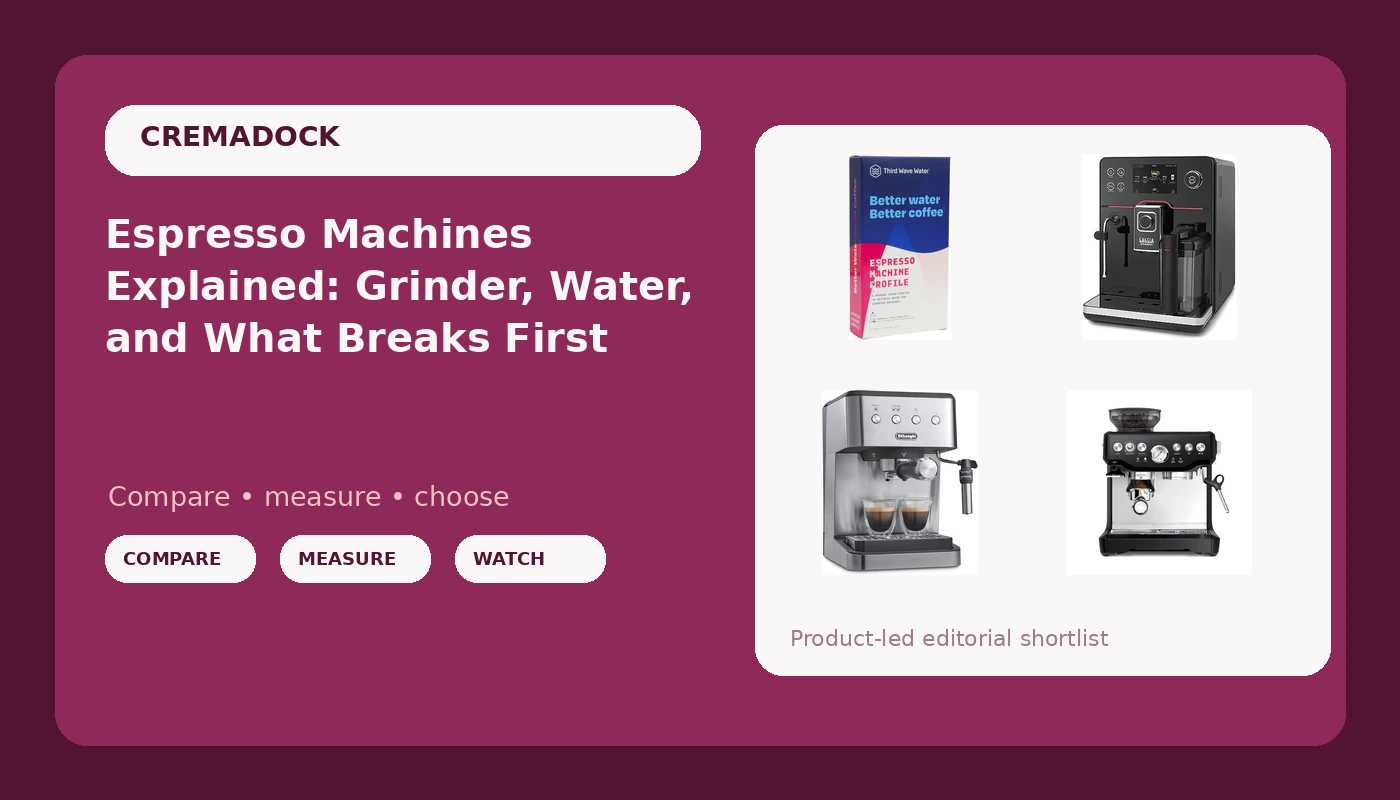
Buying a home espresso machine is closer to signing a maintenance contract with a pump attached than to buying a toaster. The good news is that the market beneath a thousand dollars splits cleanly into three designs, and each one asks something different of you on a Tuesday morning when you are already late for work. Manual machines leave grind, dose, and shot timing in your hands. All in one machines put a burr grinder and a brew group in the same chassis. Fully automatic machines handle everything internally and hand you a cup. There is also a fourth decision almost nobody makes on purpose, which is the water going into the boiler, and that one quietly decides whether a machine lasts nine years or dies at eighteen months. This explainer walks through home espresso machines piece by piece and shows where each option actually fits.
Related: How to Descale an Espresso Machine Without Killing It →
Quick answer
Match the machine to the work you will honestly do at 6 a.m., not to the machine you would admire on a Saturday afternoon. A compact manual machine such as the De'Longhi Classic fits a small counter and a small budget, and it assumes you already own a burr grinder or buy coffee ground for espresso. An all in one such as the Breville BES870BTR Barista Express puts the grinder in the same box and suits most households that want real espresso from a single purchase. A fully automatic machine such as the Gaggia Accademia trades technique for a drink menu and a rinse routine. Whichever you choose, treat the water as part of the machine: Third Wave Water's espresso profile is one way to control the minerals your boiler is heating, and that is often the difference between a descale you do twice a year and a boiler you replace.
Four useful options
| Model | Best fit | What stands out |
|---|---|---|
| Breville BES870BTR Barista Express Espresso Machine, Black Truffle | One purchase that covers grinding and brewing | Integrated conical burr grinder feeding a manual brew group |
| De'Longhi Classic Espresso Machine, Milk Frother, Stainless Steel | Small kitchens and first machines | Compact manual design with a built in milk frother and stainless steel housing |
| Gaggia Accademia Luxury Italian Fully Automatic Espresso Machine with 19 Customized drink settings,0.5 Liters,RI9782/46 Brushed Stainless | Push button drinks with minimal technique | Fully automatic with 19 customized drink settings and a 0.5 liter water tank |
| Third Wave Water - Espresso Machine Profile, Five(5) Gallon Sticks | Controlling what goes into the boiler | Five sticks, each intended for one gallon of distilled water |
The all-rounder: Breville BES870BTR Barista Express Espresso Machine, Black Truffle
The trade off with an all in one is that the grinder and the brew group share one failure timeline. If either half quits, you are repairing or replacing the whole unit instead of swapping one appliance out. I ran the BES870XL version of this machine every day for nine years before it finally gave up the ghost, and the honest shape of the deal is this: it rewards a real cleaning routine and it punishes neglect, but you only need one outlet and one patch of counter. The included portafilter and tamper are also unusually usable for a bundled accessory, which matters more than it sounds, because a bad tamper is the first thing most people replace.
The compact starter: De'Longhi Classic Espresso Machine, Milk Frother, Stainless Steel
Buying a machine without a grinder is a real choice, not a shortcut, as long as you are honest about the second purchase it implies. The grinder is half the machine. A capable manual espresso machine paired with pre-ground coffee from a supermarket will produce flat, fast shots no matter how carefully you tamp, because the grind was set for a different brewer weeks ago. If you go this route, budget for a burr grinder in the same mental transaction, even if the grinder arrives months later. The other thing to know about machines at this level is that warm up time matters more than people expect, and a smaller boiler is quicker to reach temperature but less stable across back to back shots.
The push button option: Gaggia Accademia Luxury Italian Fully Automatic Espresso Machine with 19 Customized drink settings,0.5 Liters,RI9782/46 Brushed Stainless
A super automatic is for someone who wants a latte button, not a hobby, and there is nothing wrong with that as long as the trade is understood. You give up control over grind size, dose, and preinfusion, and you take on a machine with more internal parts, a milk system that needs rinsing, and a cleaning cycle you cannot skip. The half liter tank is worth thinking through carefully: if two people each make a milk drink every morning, you will refill it often, and a tank you cannot see the level of from the front is how machines get run dry. Running a boiler dry is how machines die young, so check the level before you walk away.
Prices and availability may change. Product images, names, and retailer links must be matched by verified ASIN. Do not state a current price, rating, stock status, or measured result without current evidence.
The one nobody plans for: Third Wave Water - Espresso Machine Profile, Five(5) Gallon Sticks
Water is the least glamorous purchase here and the one with the longest consequences. Every descale is a negotiation with whatever your municipal supply put in the water, and hardness varies enormously from one zip code to the next, which is why two owners of the same machine can have completely different experiences. Distilled water on its own has had its minerals stripped, and mineral content is what carries flavor into the cup, so a profile product exists to put a known quantity back. Read the directions on the stick before you mix, and remember that this is a consumable, not a one time fix.
What actually separates these machines
Manual, all in one, and fully automatic describe who does the work, not how good the espresso is. On a manual machine you grind, dose, tamp, lock the portafilter into the grouphead, and decide when to stop the shot. On an all in one you still tamp and still stop the shot, but the grinder is bolted to the same frame and its settings live on the same panel. On a fully automatic the machine grinds, doses, tamps, and brews, and your only inputs are bean choice, water, and which button you press.
Espresso itself is a narrow target. Water is pushed through a compacted puck of finely ground coffee at pressure, and the result should arrive in roughly the time it takes to fill a small glass. The puck, the compressed disc left in the portafilter after the shot, is your feedback loop: a soupy, uneven puck usually means the grind or the dose was off, not that the machine is broken. A pressure gauge is invaluable because it tells you what the pump is actually doing rather than what the marketing page claims, and if a machine has one, learn to read it.
The grinder is the part people underweight most. Two machines with identical brew groups will taste different with different grinders, because grind consistency determines how evenly water moves through the puck. This is why a machine without a grinder is not automatically a worse purchase, but it is an incomplete one. Budget the two together and the numbers make more sense.
Water, scale, and the maintenance contract
Descaling means running a descaling solution through the boiler to dissolve the mineral buildup that accumulates every single time you heat water. Skip it and the machine dies from the inside, slowly, with symptoms that look like a failing pump. How often you descale depends on your water, your usage, and whether you filter. That is the entire argument for controlling water quality rather than reacting to it.
- Keep the tank above the minimum line. A dry boiler is how machines die young, and no feature protects you from it.
- Descale on a schedule tied to your water hardness and your shot count, not to the day the machine finally complains.
- Replace water filters on the interval the manufacturer states rather than when the water starts tasting odd.
- Rinse the milk side of any machine with a frother or an automatic milk system immediately after use, because dried milk is the worst thing to remove later.
- Keep a record. A note on your phone listing the last descale date makes the six month question answerable instead of a guess.
How to choose in five steps
- Count how many drinks you make on a normal weekday and multiply it by the number of people in the house. That number decides tank size and refill annoyance more than any spec.
- Decide whether you will grind. If the answer is no, buy a machine accordingly and accept the ceiling that comes with pre-ground coffee.
- Decide whether you want to learn technique or press a button. Neither answer is wrong, but only one of them leads to a machine you will still enjoy in year three.
- Budget the grinder, the water, the descaler, and the filters alongside the machine. The purchase price is the down payment, not the total.
- Ask what breaks first and what the part costs. A machine with a documented, cheap failure point is a different long term proposition than one nobody has opened up.
Practical guidance
- Measure your counter before ordering. Depth matters more than width because the portafilter handle and the drip tray both need room to move.
- Pull two shots back to back on day one and again on day thirty. Consistency across consecutive shots tells you more than a single perfect shot ever will.
- Taste your tap water on its own. If you would not drink it, reconsider what you are asking your boiler to heat every day.
- Learn one drink well before chasing variety. A repeatable latte beats five mediocre ones, and it teaches you what the machine is doing.
- Keep the box and the manual. Parts, filters, and descaling instructions are easier to source when you know the exact model number.
Which option should you choose?
Choose the De'Longhi Classic Espresso Machine, Milk Frother, Stainless Steel when you have limited counter space, a limited budget, and you are willing to pair it with a real burr grinder or accept the ceiling of pre-ground coffee. Choose the Breville BES870BTR Barista Express Espresso Machine, Black Truffle when you want one purchase that covers grinding and brewing, and you are willing to keep up with a cleaning and descaling routine. Choose the Gaggia Accademia Luxury Italian Fully Automatic Espresso Machine with 19 Customized drink settings,0.5 Liters,RI9782/46 Brushed Stainless when you want a drink menu and a button, and you would rather rinse a milk system than learn to tamp. Add Third Wave Water - Espresso Machine Profile, Five(5) Gallon Sticks when you want a known mineral profile going into the boiler instead of whatever your tap delivers.
A caveat worth stating plainly: none of these machines will fix stale beans or a grinder that cannot grind fine enough for espresso. Those two variables sit upstream of everything the machine does. Fix them first, then shop.
The bottom line
The machine is the easy part of the decision. What separates a purchase you still like in year three from one gathering dust in month four is whether the design matches your morning, whether the grinder can keep up, and whether you will actually descale on schedule and keep water in the tank. Pick the design that fits your real routine, budget for the grinder and the water alongside it, and treat the cleaning cycle as a mortgage payment rather than a suggestion.