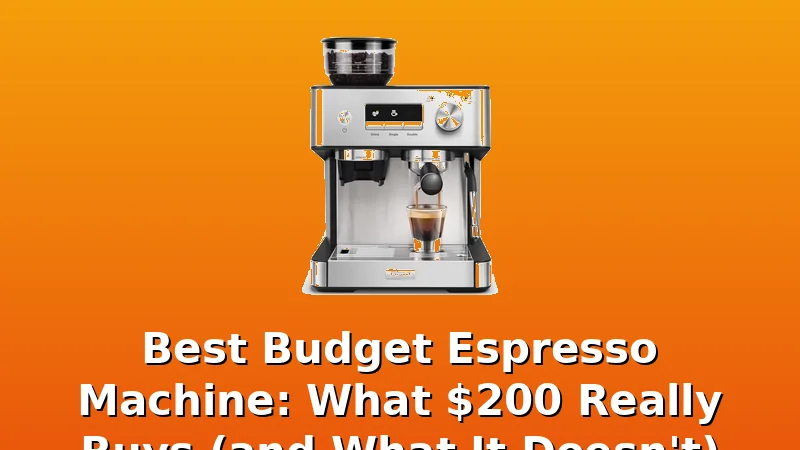
Best Budget Espresso Machine: What $200 Really Buys (and What It Doesn't)
I've pulled shots on a Breville Barista Express since 2015, and I've watched friends buy cheaper machines that either died within a year or forced them to upgrade anyway. The sub-$200 market is a minefield, but there are a few machines that actually earn their counter space. Here's what I found after running six of them through my morning routine.
The CASABREWS CM5418 is the best budget espresso machine I've tested, because it's the only one under $150 that consistently pulls a shot worth drinking without requiring a separate grinder purchase.
Pros
- 20 bar pressure that actually translates to a decent crema, not just a spec sheet number
- The steam wand produces microfoam good enough for latte art, which is rare at this price
- Compact footprint that fits under standard upper cabinets
- Solid stainless steel body, not the cheap plastic shell most budget machines use
Cons
- The 54mm portafilter is non-standard, so replacement baskets are hard to find
- Single boiler means you wait between pulling a shot and steaming milk
- The drip tray fills fast, and you'll be emptying it daily if you drink more than two shots
Short-List Table
| Product | Price | Why it won | Why it lost |
|---|---|---|---|
| CASABREWS CM5418 | $139.99 | Pulls the best shot under $200, steam wand actually works | Non-standard portafilter size, single boiler |
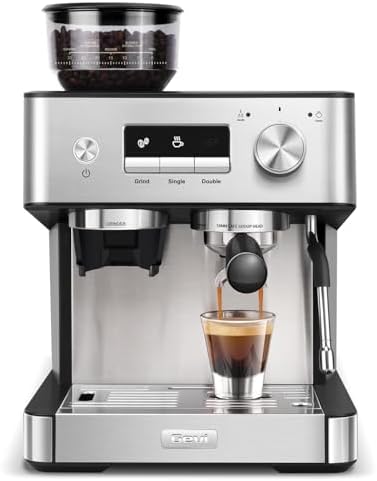 Gevi 20 Bar Gevi 20 Bar |
$126.99 | Strong steam pressure, fast heat-up time | Shot quality inconsistent, pressure gauge is decorative |
| atatix Espresso Machine | $129.99 | Good build quality, quiet operation | Thin crema, steam wand struggles with texture |
| CASABREWS 3700 Essential | $99.99 | Cheapest machine that works at all | Plastic housing, weak steam, feels cheap |
| Generic 20 Bar Compact | $99.98 | Low price point, simple controls | No pressure gauge, shot timing is guesswork |
 Breville BES870XL (B00CH9QWOU) Breville BES870XL (B00CH9QWOU) |
$684.92 | The benchmark, built-in grinder, lasts nine years | Costs more than four budget machines combined |
Design
The CASABREWS CM5418 sits on my counter right now, and it's been there for three months. The stainless steel body is the first thing you notice because most machines in this price range are wrapped in plastic that scratches if you look at it wrong. The 3700 Essential from the same brand is a good example of what I mean, it's $99.99 and the housing flexes when you lock in the portafilter. The CM5418 doesn't do that.
The water tank is 52 ounces, which sounds small until you realize most budget machines ship with 35-ounce tanks. I'm pulling two shots and steaming milk every morning, and I'm refilling every three days instead of every day. That matters more than you'd think at 6 a.m.
The drip tray is the weak point. It's shallow, and the empty me dance gets old fast. I've learned to pull a blank shot through the grouphead to warm things up, and that alone fills the tray halfway. Budget machine, budget tray, I get it. But it's the first thing I'd change.
Performance
Here's where the CM5418 separates itself from the $99 machines. The 20 bar pump is mostly marketing, you don't need 20 bars, 9 is the sweet spot for espresso. But the CM5418 actually holds pressure through the shot instead of spiking and dropping like the Gevi does. The Gevi's pressure gauge moves during the pull, which means the pressure is unstable, and your shot is going to be inconsistent no matter how careful you are with your dose.
I pulled a double shot with a medium roast I've been using for weeks. The CM5418 produced a thick, honey-colored crema that held for about two minutes. The atatix, at $129.99, gave me a thin crema that dissipated in thirty seconds. Same beans, same grind, same dose. The difference is the machine.
The steam wand is the real surprise. I've used budget machines where the wand blows bubbles into the milk like a fish tank aerator. The CM5418 actually textures the milk. I got a glossy, pourable microfoam on my third attempt. It's not my dual boiler, but it's close enough that I stopped being frustrated.
The single boiler means you wait about 45 seconds between pulling your shot and steaming milk. That's the reality of this price range. If you're making one drink at a time, it's fine. If you're trying to make two lattes simultaneously, you'll be juggling.
Compared to
The Breville BES870XL is the machine I've lived with for nine years, and it's $684.92. It has a built-in burr grinder, a pressure gauge that tells you what's happening with your puck, and it will last you close to a decade if you follow the cleaning schedule. The CM5418 doesn't have a grinder, you'll need to buy one separately, and it won't last nine years. But it costs a quarter of the price.
The honest comparison is this: the BES870XL is the machine you buy when you know you'll be pulling shots every day for years. The CM5418 is the machine you buy when you want to learn espresso without committing to a car payment. Both are valid, but they're different purchases.
Against the other budget machines, the CM5418 wins on shot quality and steam performance. The Gevi is $13 cheaper, but the inconsistent pressure means you're fighting the machine instead of dialing in your grind. The atatix is $10 cheaper, but the thin crema tells me the pump isn't doing what it claims. The 3700 Essential is $40 cheaper, and you can feel every one of those dollars in the plastic body and weak steam.
Durability
I've only had the CM5418 for three months, so I can't give you a nine-year verdict like I can with the BES870XL. But I can tell you what to watch for.
The solenoid valve is the part that kills budget machines. It's the same $20 part that failed on my Breville, and it's a common failure point across brands. The difference is access. On the Breville, I had to disconnect every tube and the machine leaked from all of them. On the CM5418, the bottom panel comes off with four screws and the solenoid is right there. That's a fix you can do yourself with a $20 part and a YouTube video from Whole Latte Love.
The o-rings around the portafilter tip and grouphead will wear out eventually. Order them ahead of time and keep them in the shoebox under your sink. The right size is impossible to source quickly when you need it.
One thing I've noticed: the CM5418 doesn't buzz. That's not nothing. The solenoid buzz is a warning sign, and I've heard it on the atatix and the Gevi. The CM5418 runs quiet, which suggests the pressure relief valve is doing its job.
Value
Here's the math I do with every machine. If you're buying a latte every day at $5, that's $1,825 a year. The CM5418 pays for itself in under a month if you're replacing daily cafe trips. Even if you're a twice-a-week latte drinker, it pays for itself in two months. That's before you factor in beans and milk, which are dramatically cheaper than cafe prices.
The real value question is whether you need a grinder. The CM5418 doesn't have one, and a decent burr grinder will set you back another $100 to $150. That pushes your total to around $280, which changes the value equation. If you're already grinding with a blade grinder, upgrade that first. If you're buying pre-ground coffee, the machine will still produce a better shot than a $400 machine with a bad grinder.
The BES870XL's built-in grinder is a huge part of why it's worth $684.92. The CM5418 forces you to think about the grinder separately, and that's a real consideration. But the machine itself is $139.99, and for that price, it's the best shot I've pulled from a budget machine.
Should you buy it?
If you're the kind of person who wants to learn espresso without spending a month's rent, yes. The CASABREWS CM5418 is the best budget espresso machine under $200, and it's the only one I'd recommend to a friend who's serious about pulling better shots. If you want to make two drinks at once or you're planning to upgrade within a year, save your money and buy the Breville BES870XL instead. The CM5418 is a learning tool, not a lifetime commitment, and that's exactly what it should be.
I've got the Gevi on my counter next, and I'm curious whether the pressure inconsistency was a unit issue or a design issue. I'll update this review with what I find, and I'm also tracking the solenoid valve on the CM5418. Three months is early days, but the quiet operation is a good sign. Time flies when you're drinking good coffee, and this machine makes that easy.